

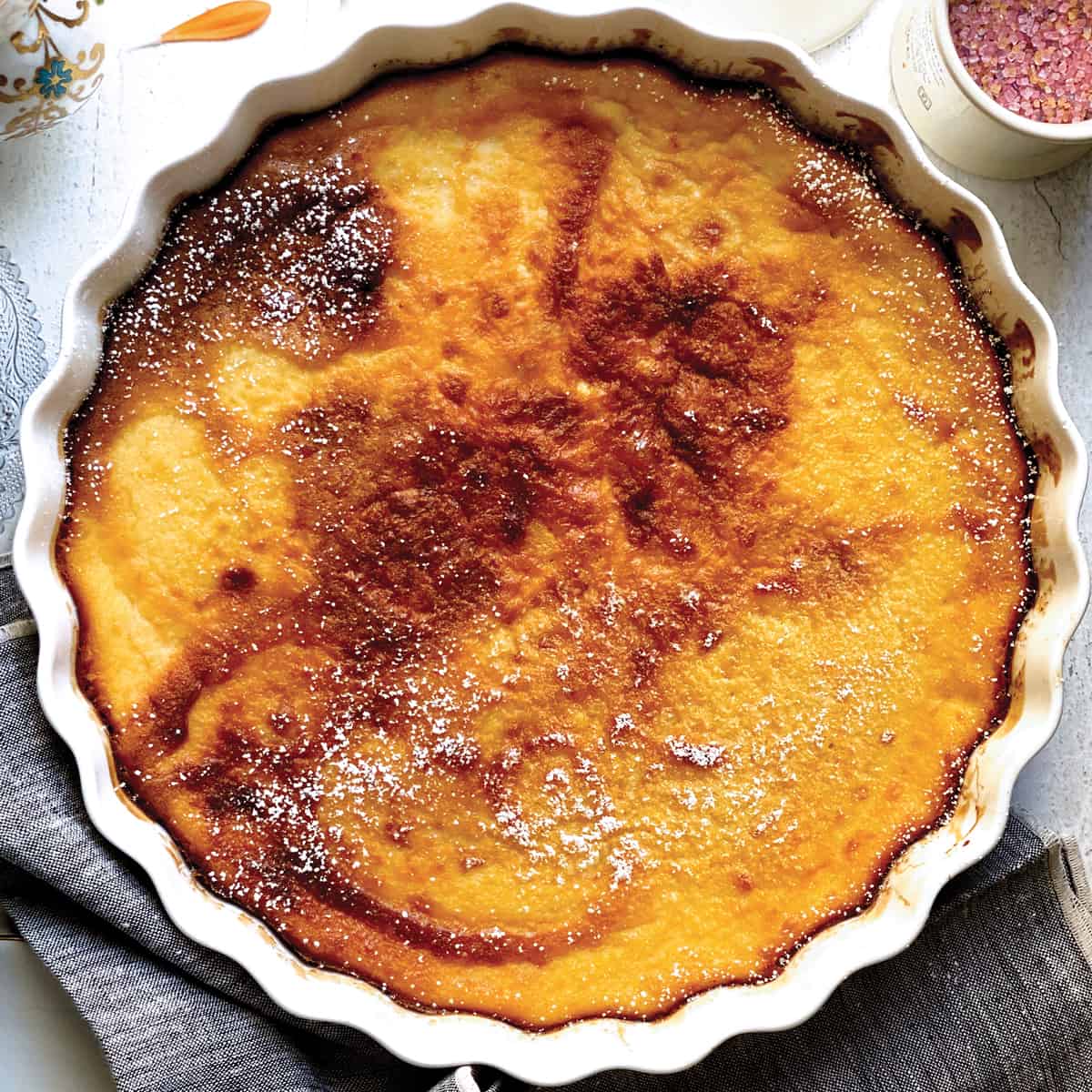
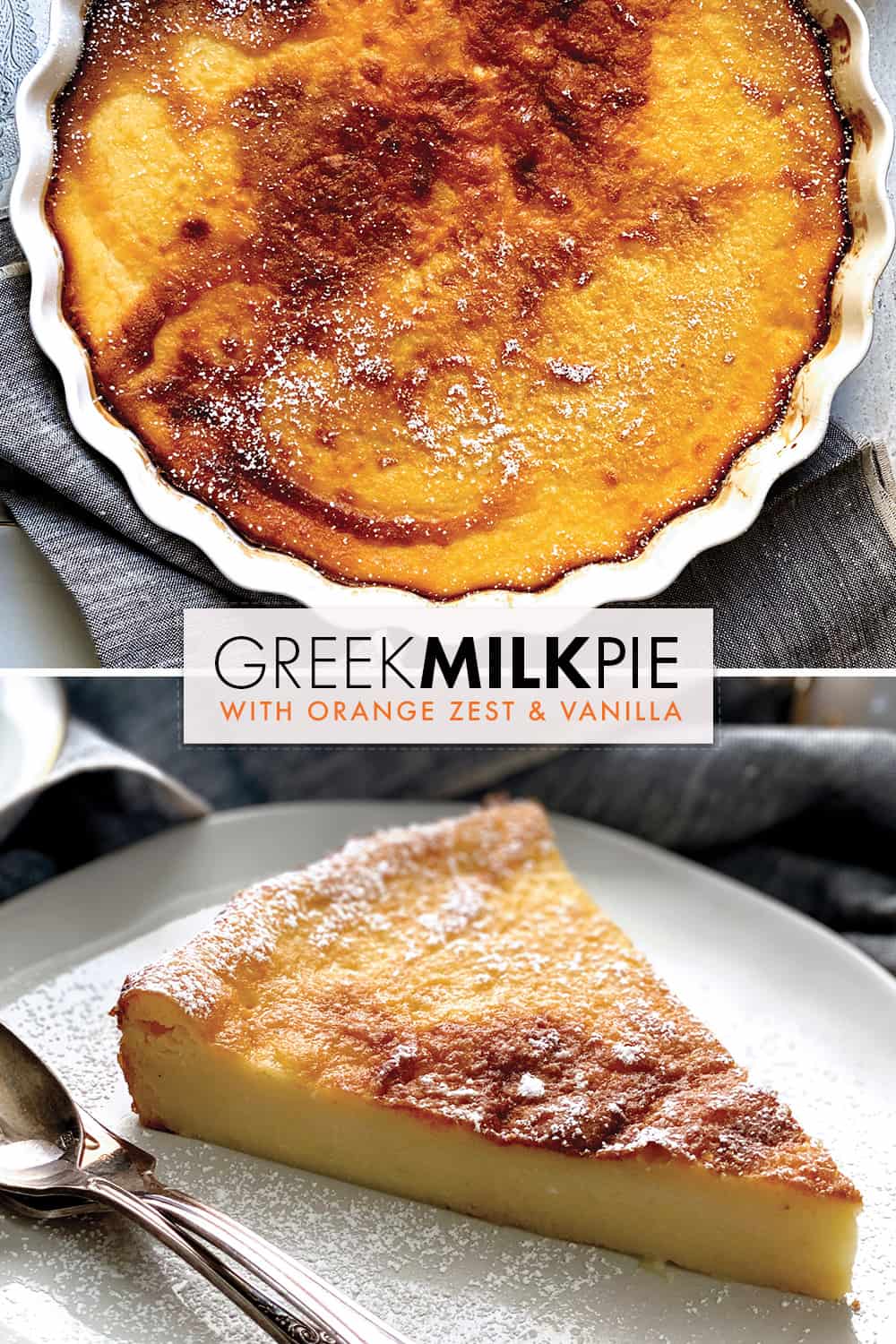
Galatopita is the Greek milk pie I grew up eating: a creamy, crustless custard of milk, fine semolina, eggs, and butter, scented with orange zest and vanilla and baked until the top turns golden and freckled. Yiayia Evgenia always baked hers in an aluminum pan; I use a ceramic tart pan, and both work beautifully.
It takes about 15 minutes of hands-on time and a few pantry staples. Serve it with a dusting of confectioners’ sugar and cinnamon, warm or straight from the fridge.
If you love this galatopita recipe, you will also love this portokalopita – Greek orange phyllo cake, melomakarona – honey cookies, or Greek yogurt with honey, figs, walnuts, and mint!

What is galatopita?
Galatopita (γαλατόπιτα, pronounced gah-lah-TOH-pee-tah) literally means “milk pie”: gala is milk, pita is pie. It’s a traditional Greek custard pie made with milk, fine semolina, eggs, sugar, and butter, baked until set and golden on top. Most versions, like this one, are crustless. Some regional versions are baked over a few sheets of phyllo. Either way, there’s no syrup, which is what sets it apart from its richer cousin, galaktoboureko.
Why you will love galatopita
Galatopita vs. galaktoboureko
Both start with the same semolina custard, but they end up as very different desserts. Galaktoboureko wraps the custard in buttery phyllo and is soaked in syrup after baking, so it’s crisp, sticky, and very sweet. Galatopita skips the pastry and the syrup entirely: the custard bakes on its own until it sets with a golden top. It’s simpler, lighter, and lets the milk shine.
You may also come across “ruffled milk pie,” a different dish made from crumpled phyllo baked in a sweet egg-and-milk custard.
Here is what you need
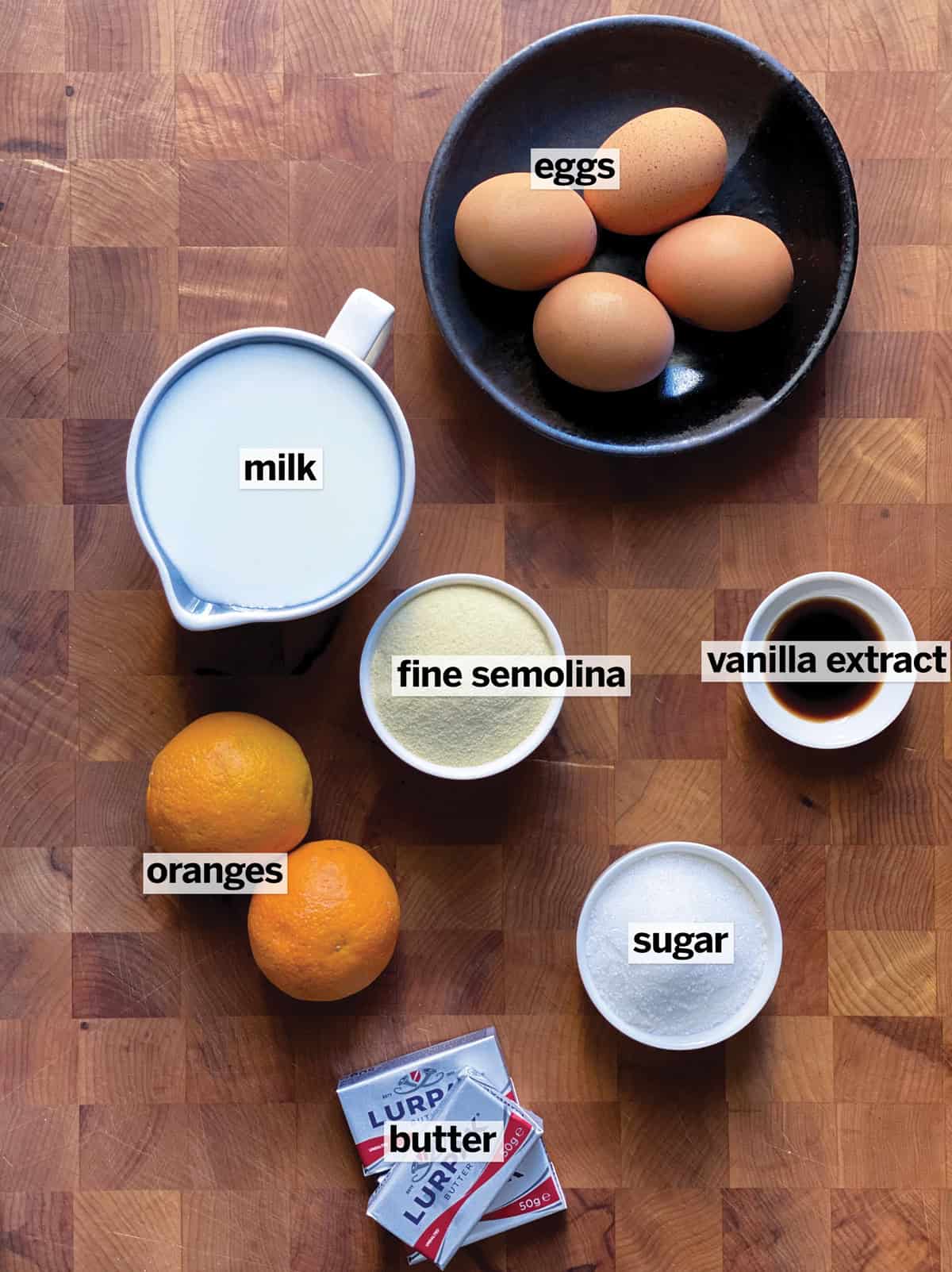
- Whole milk. The star of the show, so don’t swap in low-fat.
- Fine semolina. Look for fine semolina (psili simigdali) at Greek or Middle Eastern markets; in US supermarkets it’s often labeled “semolina flour.” Avoid coarse semolina, which stays gritty.
- Sugar, butter, and eggs. They build the rich custard base, and two extra eggs whisked with sugar make the golden top.
- Vanilla extract and orange zest. Lemon zest works too.
- For serving: confectioners’ sugar and ground cinnamon. Both optional.
How to make it

- Preheat the oven to 375°F (190°C). Butter the tart pan.
- In a medium saucepan, heat the milk over medium heat until it just comes to a boil.
- Add the sugar, then the semolina in a slow stream while whisking, and the orange zest. Whisk constantly for 2–3 minutes until slightly thickened.
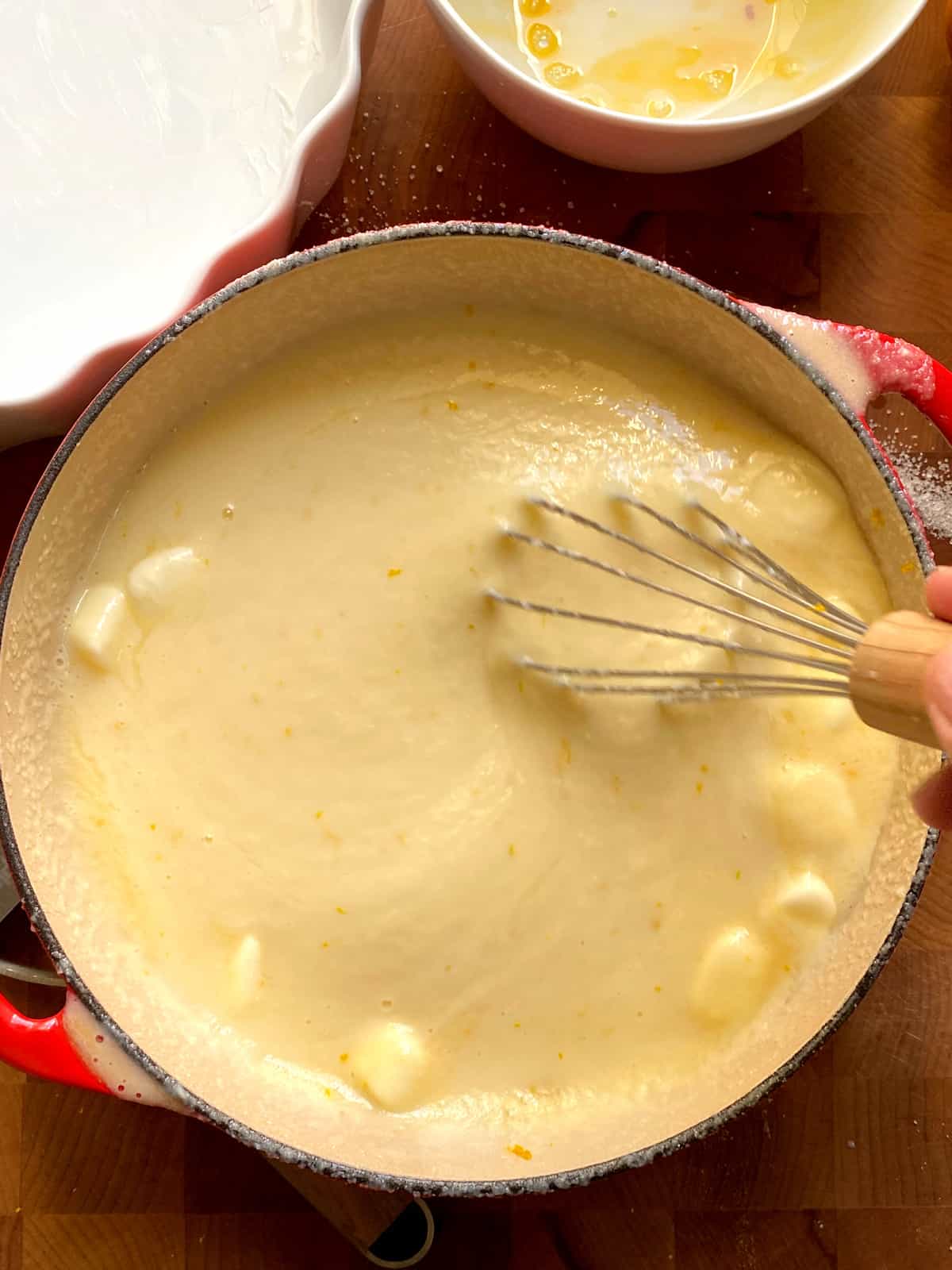
- Remove from the heat. Whisk in the butter until melted, then the vanilla and the beaten eggs, whisking quickly until smooth.

- Pour the custard into the pan and spread evenly.
- Whisk the 2 remaining eggs with 2 tablespoons sugar and pour evenly over the top.
- Bake for 45–50 minutes, until the top is deep golden and the center is set with only a slight wobble (at least 160°F/71°C on an instant-read thermometer).

- Let it rest for 15–30 minutes, then dust with confectioners’ sugar and cinnamon.

Galatopita firms up as it cools, so give it the full 30 if you want slices with clean edges.
How to store galatopita
Because it’s an egg-and-milk custard, galatopita belongs in the fridge. Don’t leave it at room temperature for more than 2 hours. Cover and refrigerate for up to 3 days. Many Greeks love it cold, straight from the fridge, but you can let a slice come to room temperature before serving.

FAQ
You may also like

Cooked it? Rate it!
If you tried this recipe, I’d love to know how you liked it — drop a comment below or tag me on Instagram @thegreekfoodie__.


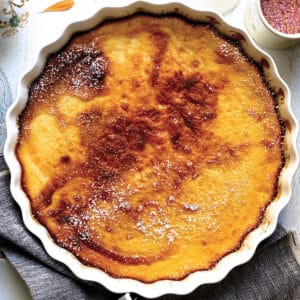
Galatopita (Greek Milk Pie)
Equipment
- 11-inch (28 cm) tart pan
Ingredients
- 4½ cups whole milk, (1 liter)
- ⅔ cup fine semolina, (125 g)
- 1 cup sugar, (200 g)
- 10 tablespoons unsalted butter, (140 g), plus extra for the pan
- 1 teaspoon vanilla extract
- 4 large eggs, room temperature, lightly beaten
- zest of 2 oranges
For the top
- 2 large eggs
- 2 tablespoons sugar
For serving – optional
- ground cinnamon
- confectioner's sugar
Instructions
- Preheat the oven to 375°F (190°C). Butter the tart pan.
- In a medium saucepan, heat the milk over medium heat until it just comes to a boil.
- Add the sugar, then the semolina in a slow stream while whisking, and the orange zest. Whisk constantly for 2–3 minutes until slightly thickened.
- Remove from the heat. Whisk in the butter until melted, then whisk in the vanilla and the beaten eggs, whisking quickly until smooth.
- Pour the custard into the pan and spread evenly.
- Whisk the remaining 2 eggs with 2 tablespoons of sugar, then pour evenly over the top.
- Bake for 45–50 minutes, until the top is deep golden and the center is set with only a slight wobble (at least 160°F/71°C on an instant-read thermometer).
- Let it rest for 15–30 minutes. Dust with confectioners' sugar and cinnamon to serve.
Notes
Nutrition


I have never tried a Greek milk pie before. Looks delicious! Excited to give it a try – thanks for the share!
So happy you like the recipe, Ann! Thank you so much! x Jenny
This looks so delicious, never tried greek milk pie before but it definitely seems like a must-try.
I am so happy you want to try the recipe! Thank you so much, Savita! x Jenny
Just wondering the size of the tart pan and if it works best with a ceramic pan or metal one? Also, have you tried substituting gluten free all purpose flour? Thanks!
Hi Dorine,
I use an 11-inch / 30 cm ceramic pan, but my grandma always made it in aluminum pans. Both should work just fine. I am sorry, have never tried gluten-free flour. If you try it, please come back and let me know if it came out right.
Thank you so much for checking out this recipe!
x Jenny
I would like to try this recipe. However I am trying to reduce added sugar as much as possible, can I use Erithritol and Monk Fruit sugar substitute instead?
Hi Alejandra,
If you have experience using erythritol and monk fruit instead of sugar, I say go for it. I haven’t tried both ingredients, but I can’t see why they would not work in this recipe. Please come back and leave us a comment if you try this version and tell us how it came out.
Thanks so much! x Jenny
I mixed this with my Greek uncles recipe and wala!!
Beautiful!
Next I’m wondering can I use almond milk or think oat milk instead of whole milk for my old peeps watching cholesterol?
What do you think ?
Kind regards
Hi Christina!
Thank you so much for making it. What is your uncles recipe? I am intrigued.
I haven’t tried plant milk. The best candidate is a nut milk like almond. If you decide to try it please come back to let me know how you liked it!
x Jenny.
Finally found the recipe to this magical cake! Thank you! I have been in search of this recipe since my husband and I shared several slices on a very early morning in Athens. This cake is magical. I have celiac so I used gluten free flour- Bob’s Red Mill Cup for Cup (blue bag). I also added vanilla. I used an emersion blender to make the filling very smooth. So lovely. Thank you so much for sharing!
You made my day, E! Thank you so much, I am so glad you found us! x Jenny