

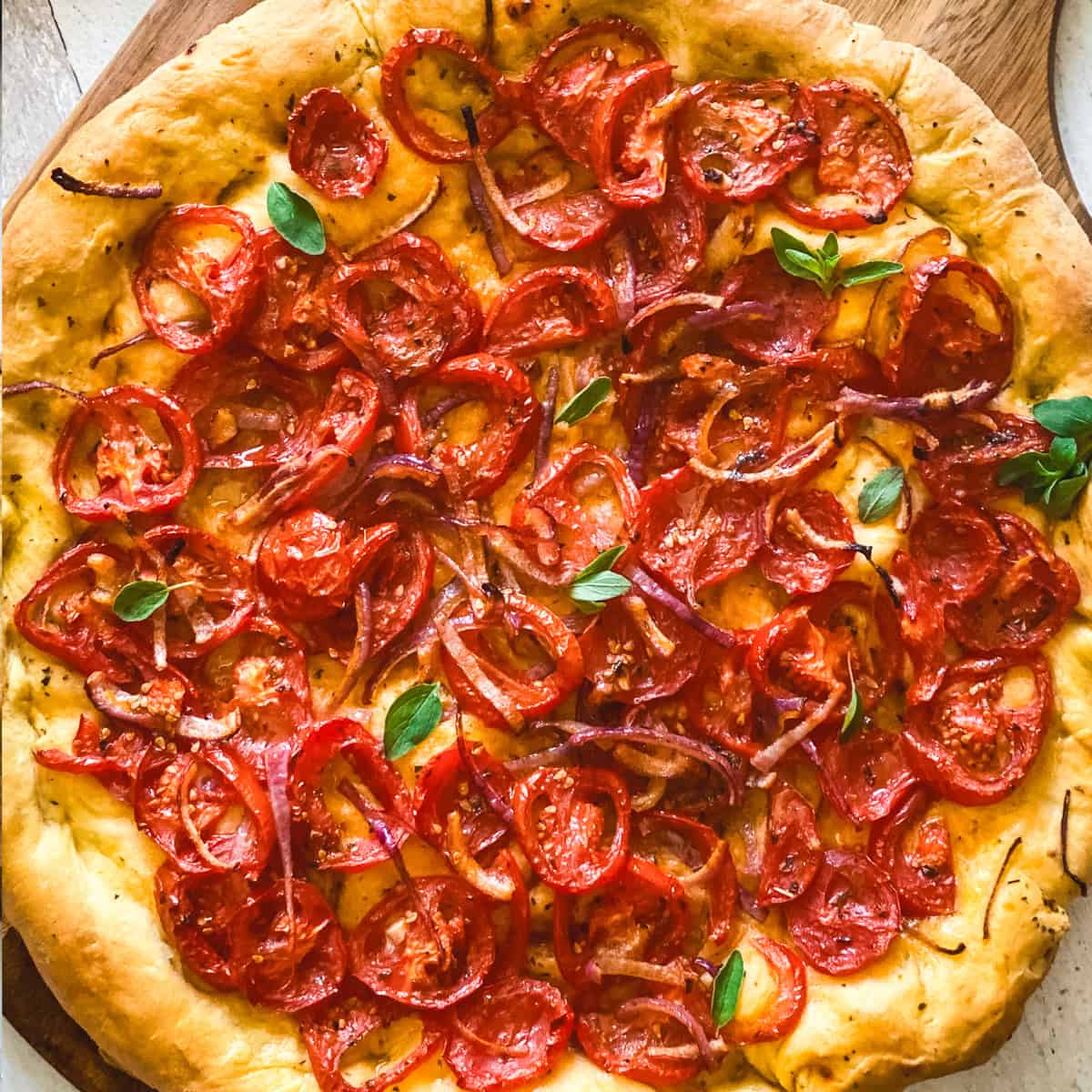
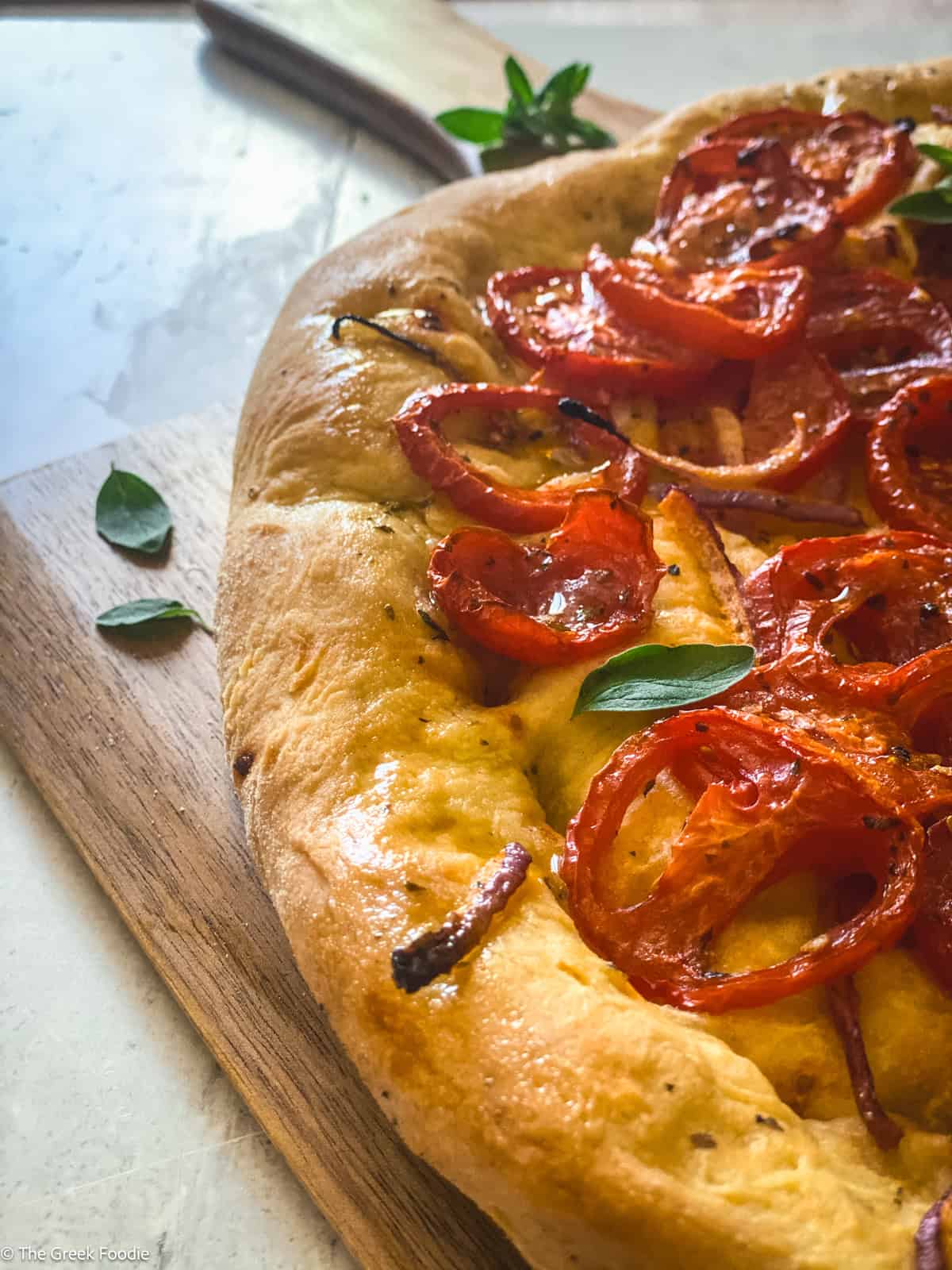
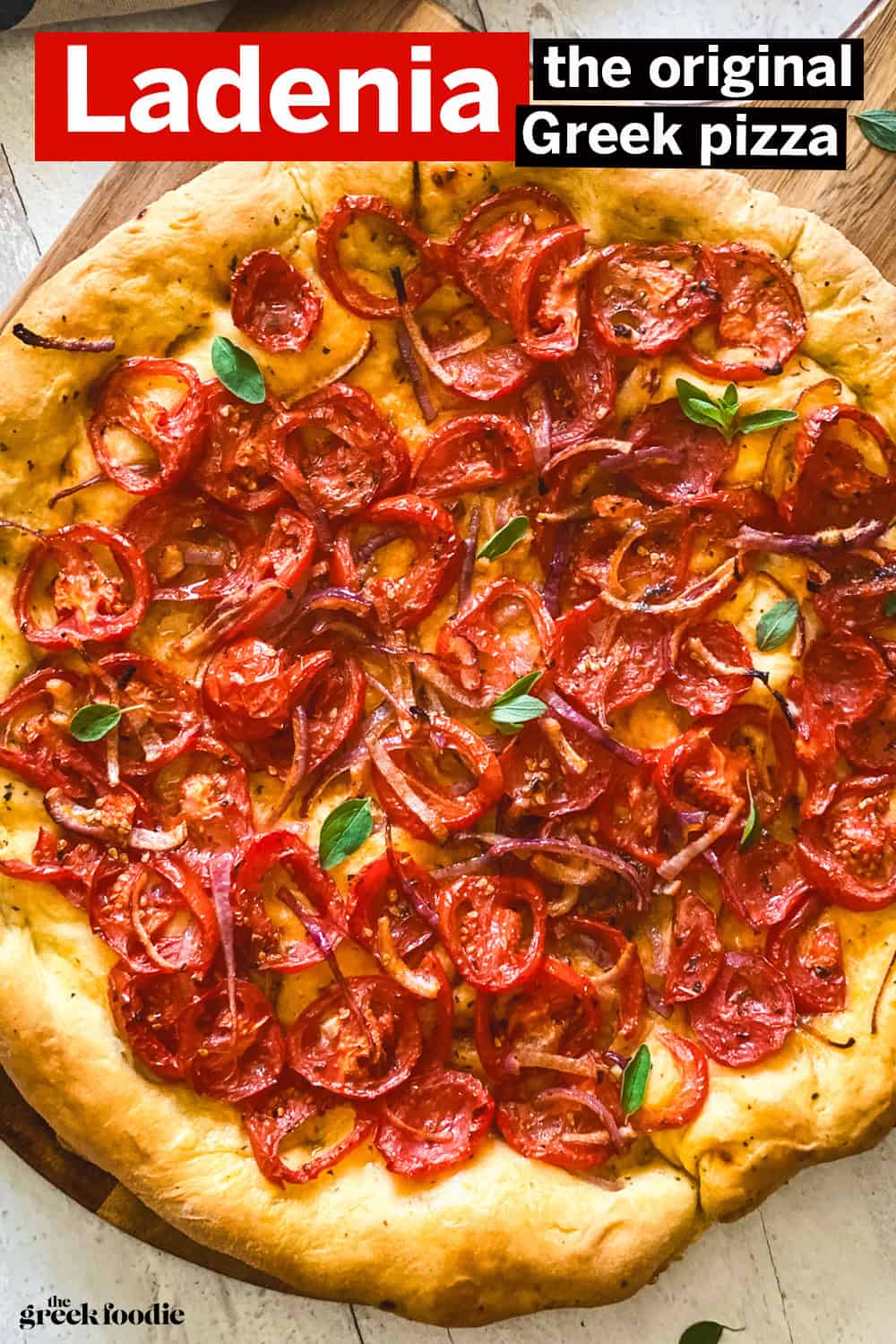
Ladenia is the original Greek pizza — a rustic, olive oil-drenched flatbread from the Cycladic island of Kimolos. The base recipe is beautifully simple and vegan: a pillowy, bread-like crust crowned with ripe tomatoes, sweet onions, dried oregano, and a generous pour of extra virgin olive oil. The magic of ladenia is how effortlessly it transforms into a full Greek pizza experience the moment you add a shower of crumbled feta, a few salty gavros (Greek anchovies), or a scattering of Cretan graviera.
I grew up eating something very close to it, and every time I make it, I think of Greek summers, breaking bread around a table with everyone talking at once. Ladenia is the kind of food that asks you to slow down and enjoy it.
If you’re a fan of Ladenia, you’re in for a treat with our Pizza with Tomatoes and Feta, Eggplant Buratta Pizza, and Easy Pita Pizza!
What is Ladenia?
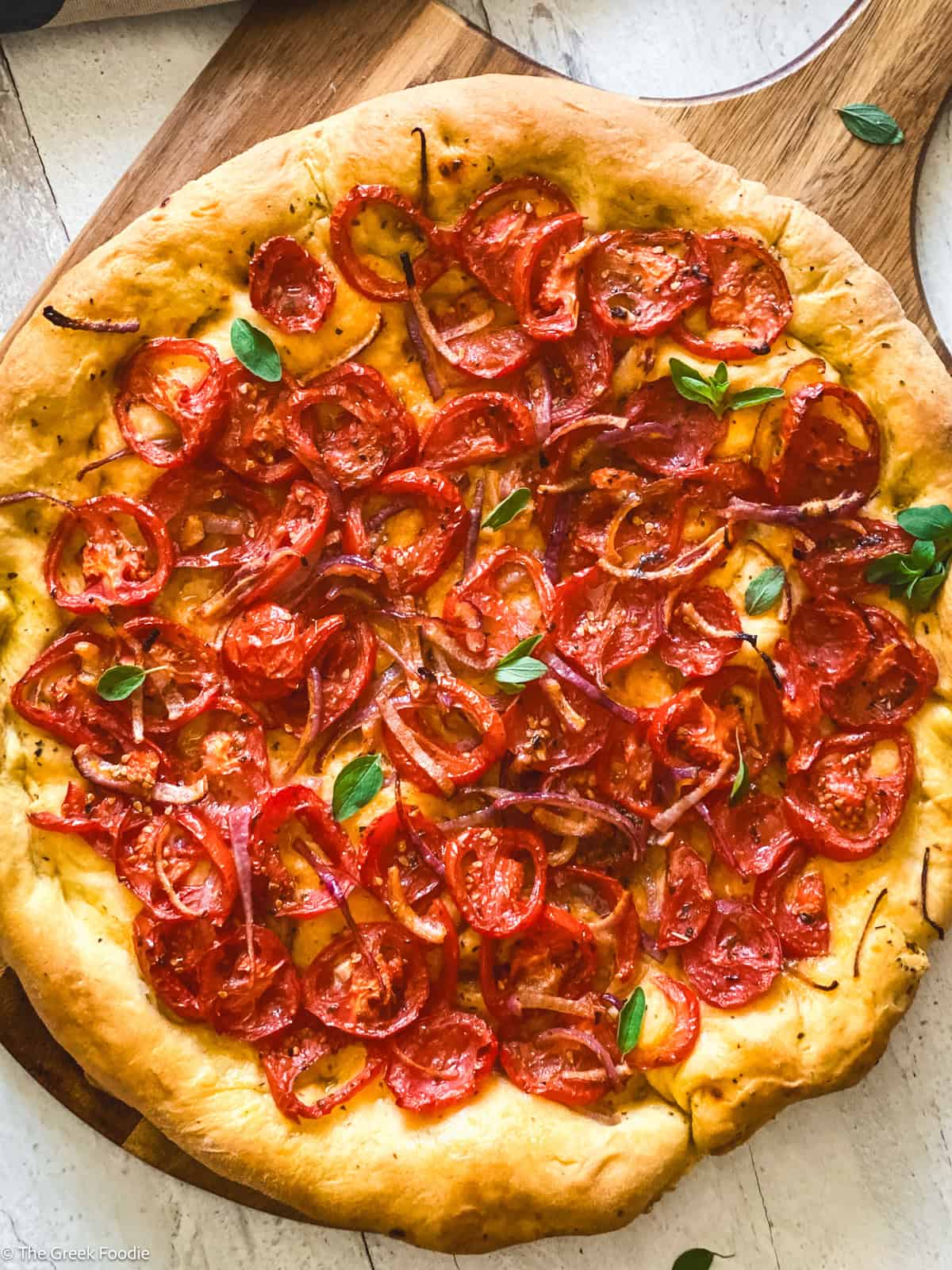
Ladenia (λαδένια) is a traditional Greek olive oil pie from the island of Kimolos, one of the lesser-known gems of the Cyclades. The name comes from the Greek word ladi (λάδι), meaning oil — and oil is very much the soul of this bread.
Historians trace the recipe back to the period of Venetian rule in the Middle Ages, when Kimolos was governed by the Duchy of the Archipelago. The island produced very few ingredients, so the recipe was born of necessity: flour, water, oil, whatever vegetables the land offered. That resourcefulness is baked right into the dough.
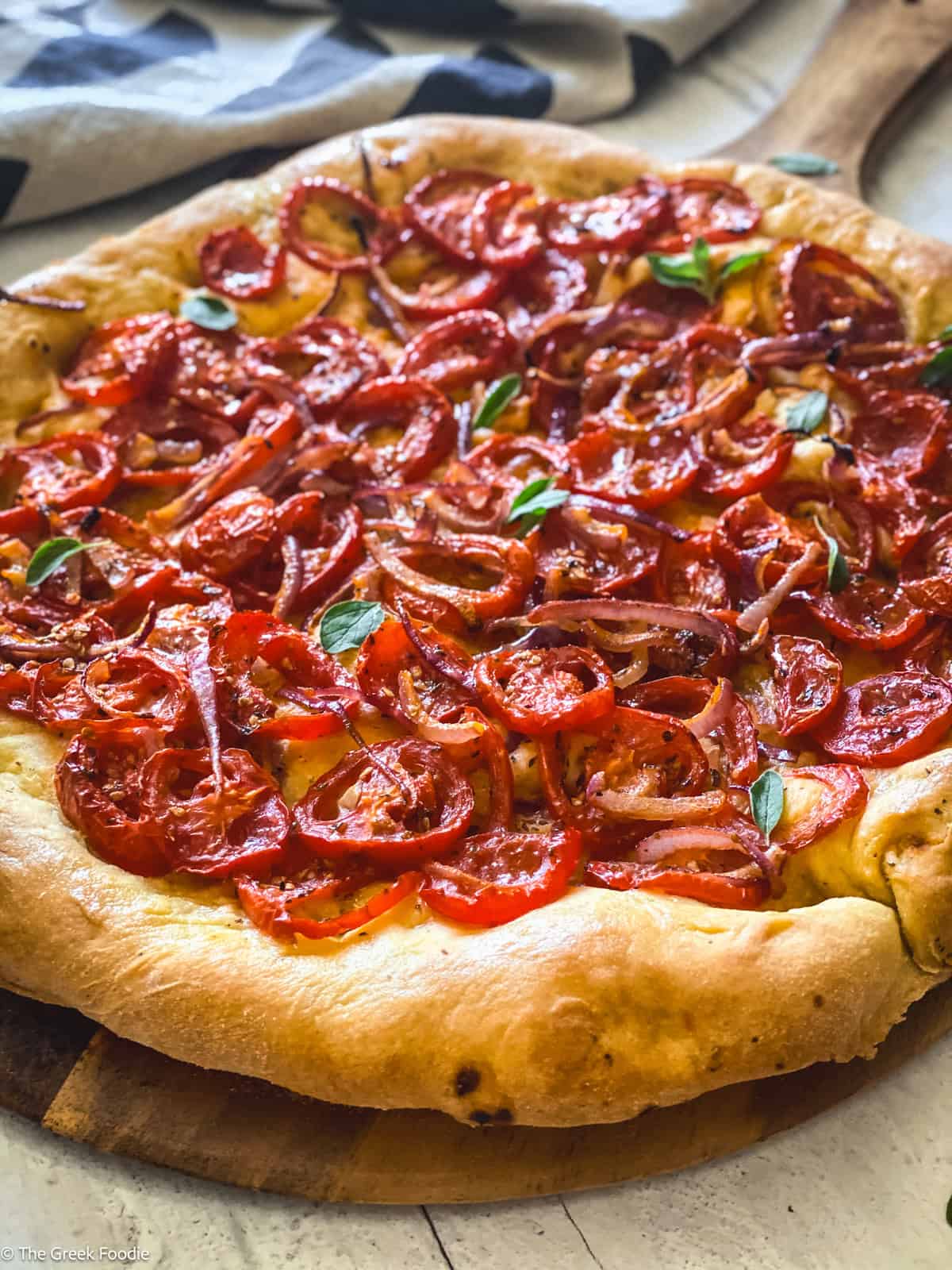
Think of it as Italy’s focaccia and Greece’s village bread having a delicious baby — except ladenia predates the modern pizza by centuries. It is naturally vegan in its classic form, making it ideal for Greek Orthodox Lenten periods when dairy and meat are avoided.
Fun fact: In Greece, we love to dip bread into the juices of a fresh tomato salad — we call it papara (παπάρα), meaning ‘soaked.’ Ladenia is that feeling turned into a whole meal.
Ingredients & Notes
This is one of those recipes where every ingredient counts — there are so few of them. Here is what you need and why.
For the Dough
Flour. All-purpose flour is what the traditional recipe uses and what I reach for first. Bread flour works too and gives a chewier, slightly more substantial crust — lovely if you like your base with a little more bite. I have not tested this with gluten-free flour, but if you have a reliable 1:1 GF blend you trust for pizza dough, it is worth trying.
Active dry yeast. One standard packet (2 teaspoons) is all you need. Always bloom your yeast first in warm water with a little sugar — if it does not foam after 15 minutes, the yeast is dead, and your dough will not rise. Start again with a fresh packet rather than waste the rest of your ingredients.
Warm water. The temperature matters: too cold and the yeast will not activate; too hot and you will kill it. It should feel like a comfortable warm bath on your wrist — about 38°C (100°F). If you do not have a thermometer, err on the slightly cooler side.
Extra virgin olive oil. This goes into the dough and all over the top, so use a good one. A grassy, slightly peppery Greek olive oil is ideal — it flavors the bread from the inside out. This is not the place for a bland supermarket bottle.
Sugar. Just one teaspoon, and it is for the yeast rather than the bread. It gives the yeast something to feed on while it activates.
Salt. Fine sea salt in the dough, coarse sea salt on top. The two work differently — the fine salt seasons the bread evenly through the crumb, while the coarse flakes on top give you little bursts of seasoning in every bite.
For the Classic Toppings
Ripe tomatoes. In summer, use the ripest, most flavourful tomatoes you can find — preferably Greek or heirloom varieties if they are available to you. The tomatoes are the sauce here; there is no passata, no concentrate. In winter, substitute with quality canned whole tomatoes (drained and sliced) or slow-roasted cherry tomatoes for concentrated sweetness.
Onion. One medium onion, cut in half and thinly sliced. It will caramelize during baking, turning sweet and jammy at the edges. Yellow onion is the classic choice; red onion adds a slightly sharper flavor and beautiful color.
Dried oregano. Greek oregano (rigani) is more aromatic and pungent than the Italian variety. If you can get your hands on the dried bunches sold in Greek delis or the one you bring back from Greece in your suitcase, use that. It makes a noticeable difference.
Extra virgin olive oil (for the top). Drizzle generously over the tomatoes and onions before baking, and again when it comes out of the oven, if you like. Do not be shy. This is an olive oil bread. The oil is not a garnish — it is part of the dish.
How to make Ladenia
Prepare the toppings
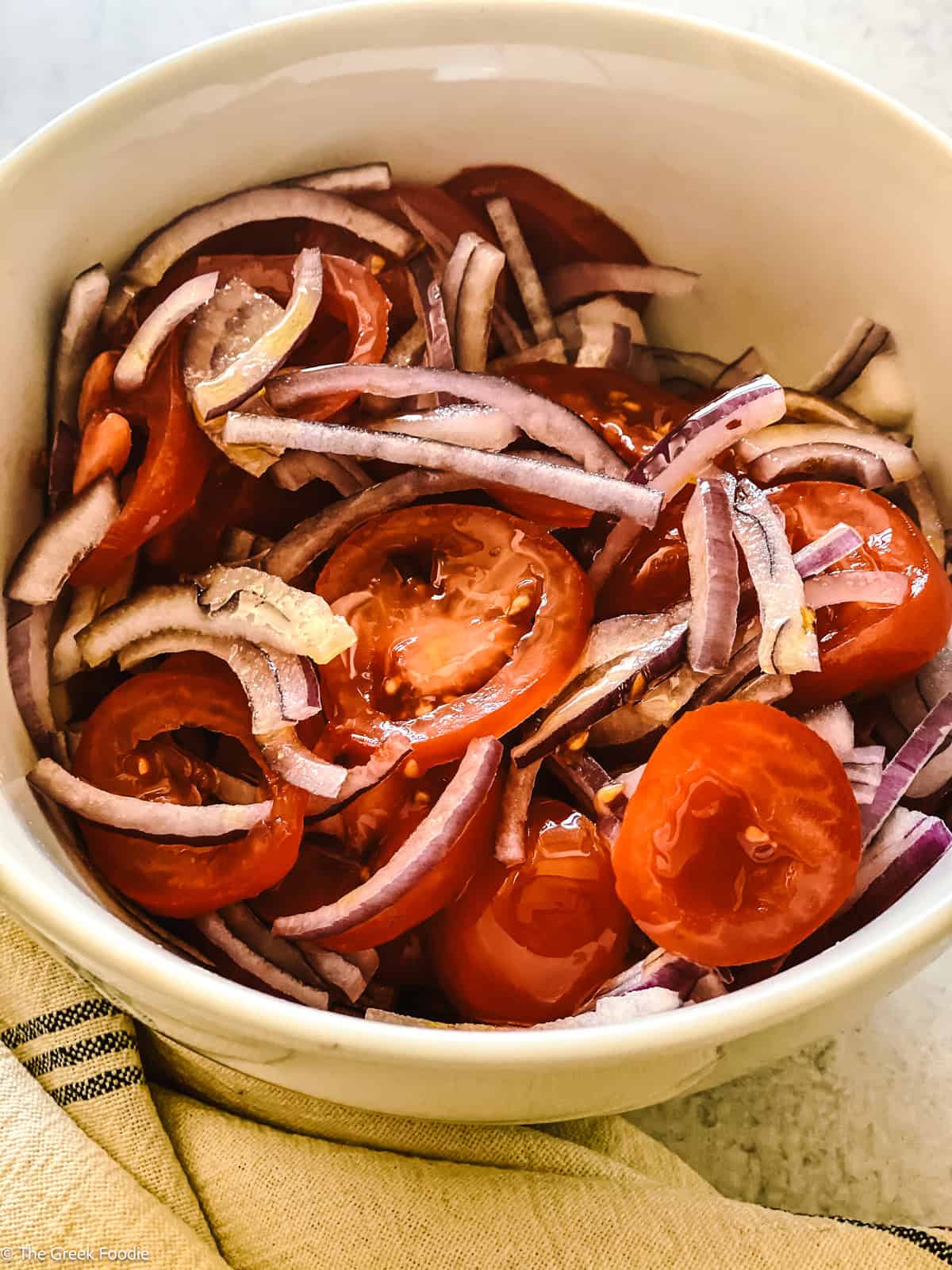
In a bowl, mix the sliced tomatoes with the onion slices. Add three or four tablespoons of oil, sea salt, and freshly ground pepper.
Start the dough
Mix the warm water, 1 tsp sugar, and 2 teaspoons active yeast in a cup. Set aside for about 15 minutes, until the mixture rises slightly and froths.
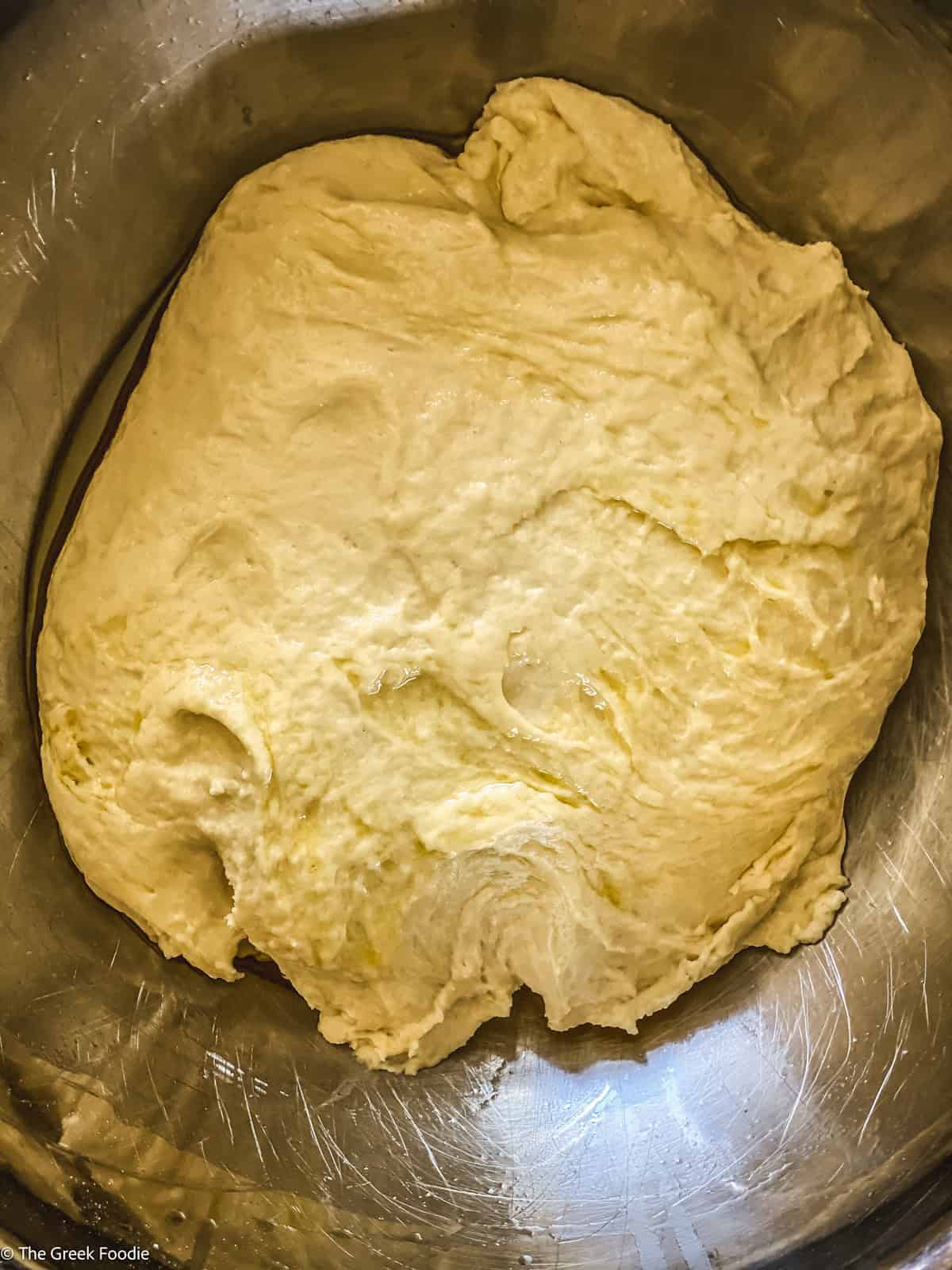
In a large and deep bowl, add the flour, sea salt, yeast mixture, and olive oil and knead for about 4-5 minutes until all the olive oil is absorbed and the dough is soft and elastic.
Let the dough rest
Cover with cling film and set aside in a warm environment for about 1 hour until it rises and almost doubles in volume.
Assemble
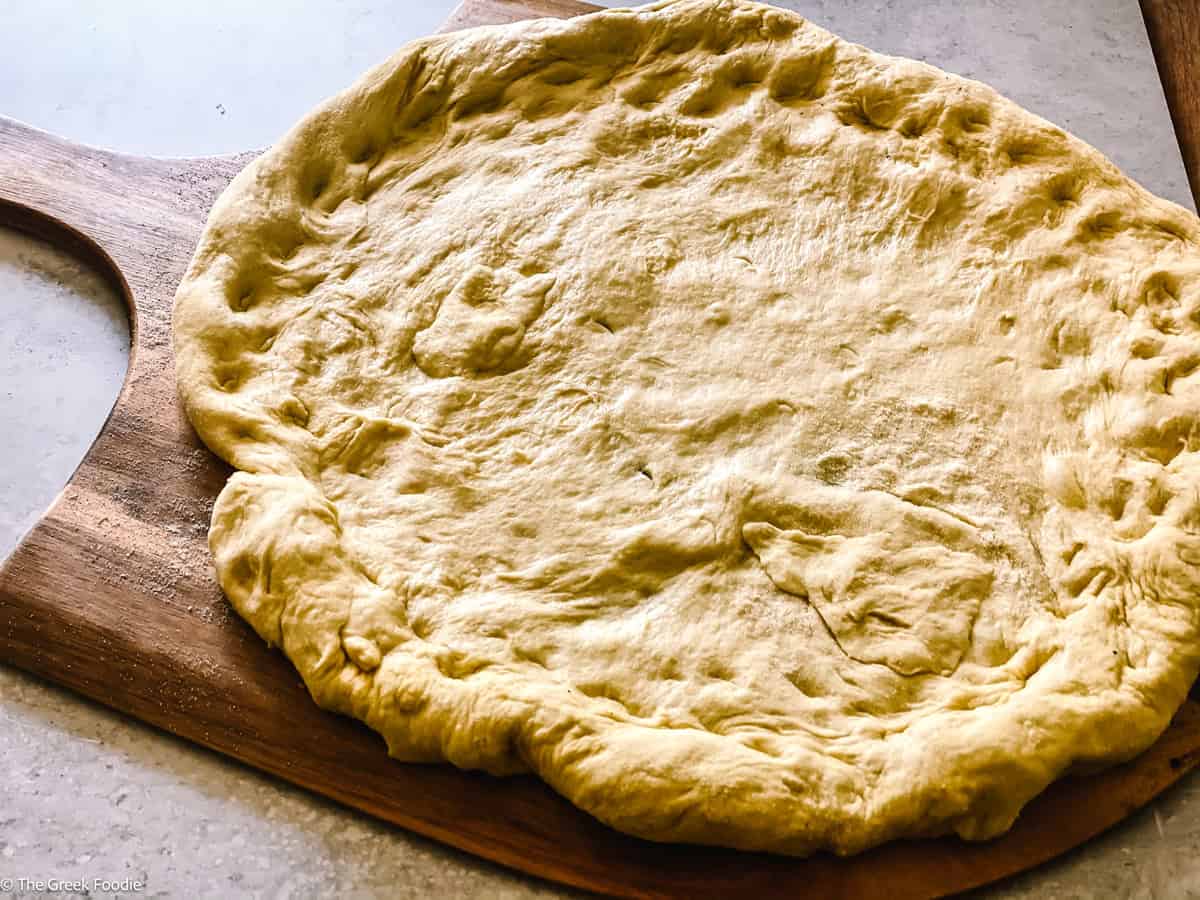
- Open the dough with your hands and fingers in a circle of about 14 inches/38 cm in diameter.
- Transfer it to a floured pizza peel if you have one; if not, transfer it directly to the pizza stone and assemble it there.
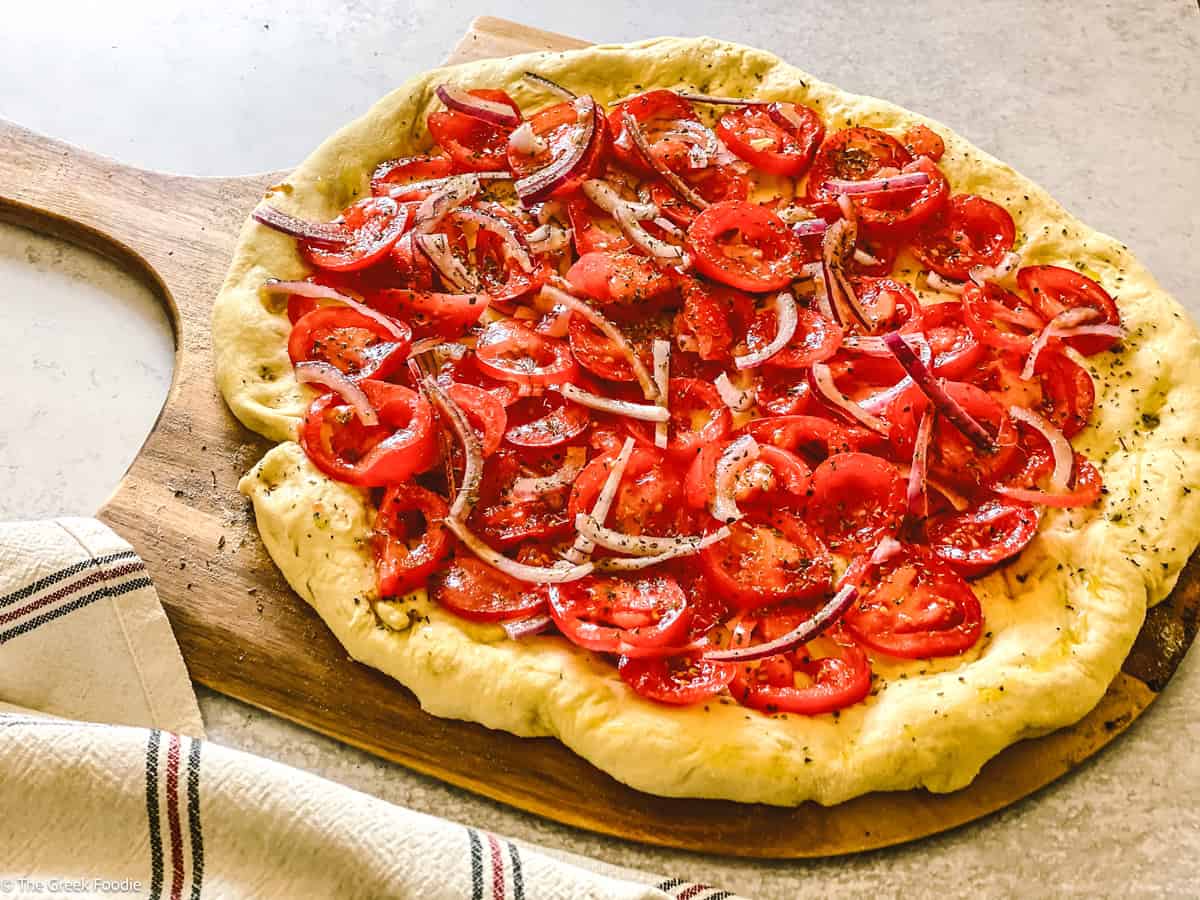
- Add the tomatoes and onions to the dough, leaving a small border around the pizza.
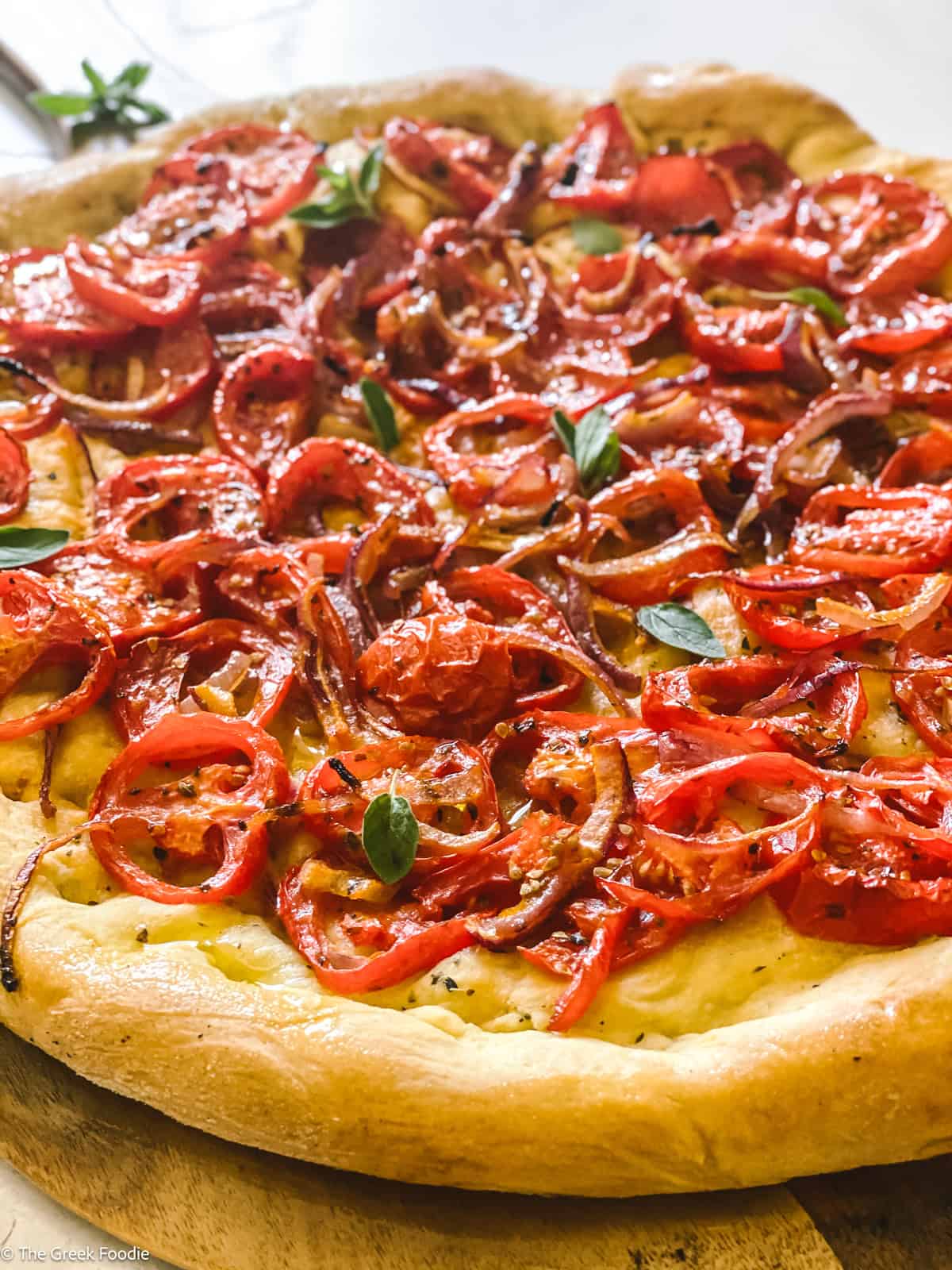
- Sprinkle with oregano, coarse salt, and freshly ground pepper and bake for about 20-30 minutes until the onions are slightly caramelized on the surface and the dough is browned below.
Ladenia Variations — The Greek Pizza Experience
The classic ladenia is perfect as is. But it also happens to be one of the best canvases for a Greek-style pizza. Here are my favorite ways to dress it up:
Feta Ladenia
The most obvious and most delicious addition. Crumble about 100g of good Greek feta over the tomatoes and onions before baking. The feta softens, its salty brine seeps into the dough, and the edges get a little golden. This is not the traditional ladenia anymore, but it is something even better.
Tip: Use a dry, firm feta (PDO feta from Greece) rather than a creamy Danish-style feta — it holds its shape better in the oven.
Graviera Ladenia
Graviera is Greece’s answer to gruyère — a semi-hard, aged cheese made in Crete, Naxos, or Lesbos. It has a nutty, slightly sweet flavor and melts beautifully. Grate or thinly slice it over the ladenia in the last 10 minutes of baking for a golden, bubbling top. This version is richer and more pizza-like than the feta version.
Halloumi Ladenia
Slice halloumi about 5mm thick and lay the slices over the ladenia in the last 5 minutes of baking. Halloumi does not melt, but it browns and develops a beautiful salty crust. If you want a slightly softer texture, pan-sear the halloumi separately and add it after the ladenia comes out of the oven.
Gavros (Anchovy) Ladenia
Gavros — Greek anchovies — are smaller and more delicate than the Italian variety, with a less aggressive salt punch. Lay a few fillets (5–8 depending on your taste) over the tomatoes before baking. They practically melt into the dough, leaving behind a deep, savory, umami backbone that makes every other ingredient taste more like itself. This is my personal favorite combination.
If you can find fresh marinated gavros (gavros marinatos), add them after baking rather than before — they are too delicate for the oven.
Olive Ladenia (for the olive lovers)
I will be honest with you — I am not an olive-on-pizza person. But many people are, and Kalamata olives are the right choice here. Pit them, halve them, and scatter them over the ladenia before baking. Their earthy, slightly bitter flavor plays beautifully against the sweetness of the caramelized onions.
The Full Greek Pizza — Feta + Gavros + Capers
This is the combination I make when I want to impress: crumbled feta, a few gavros fillets, and a teaspoon of capers scattered over the base. Bake as normal. When it comes out, drizzle with fresh olive oil and add a few fresh oregano leaves, if you have them. It is everything a Greek meze table tastes like, collapsed onto a flatbread.
Post-Bake Toppings
Once the ladenia is out of the oven and still hot, you can finish it with:
- A handful of wild or baby arugula — the heat wilts it slightly and the pepperiness cuts through the richness of the oil
- Fresh basil leaves
- A drizzle of high-quality finishing olive oil
- Lemon zest for brightness
- Flaky sea salt (Fleur de Sel or Maldon)
Pro tips
- Use the best olive oil you can afford. This recipe has nowhere to hide, the olive oil is front and center.
- Do not skip the resting time for the dough. The full hour rise gives you that light, airy, bread-like texture that makes ladenia so special.
- Use very ripe tomatoes in summer. In winter, switch to quality canned San Marzano tomatoes or slow-roasted cherry tomatoes for sweetness.
- The dough should be sticky and soft — do not be tempted to add more flour. A wetter dough produces a lighter crust.
- In a hurry? Use good-quality store-bought pizza dough. The result will still be excellent.
- Let ladenia cool for 5 minutes before slicing — the crust firms up and becomes easier to cut.
Serving Suggestions
Ladenia is at its best eaten warm, straight from the oven, cut into generous squares or wedges. Here is how I like to serve it:
- As part of a Greek pizza night spread with different variations for everyone to try
- As a meze alongside tzatziki dip, taramosalata, or a simple Greek salad
- As a main for a casual lunch or dinner — one 14-inch ladenia feeds 3–4 people comfortably
- On a picnic — it travels beautifully and tastes just as good at room temperature
Storage and leftovers
Room Temperature
Ladenia is best eaten the day it is made. It keeps well at room temperature for up to 4–5 hours, loosely covered. The crust softens as it sits, but the flavour remains excellent.
Refrigerator
Leftovers can be stored in an airtight container in the refrigerator for up to 2 days. The dough will firm up slightly in the cold, but it reheats beautifully.
How to Reheat
The oven is always the best option: place slices on a baking sheet at 180°C (350°F) for 8–10 minutes until warmed through and the edges are crisp again. A hot skillet (no oil needed — the dough has enough) works wonderfully for individual slices: 2–3 minutes per side over medium heat. Avoid the microwave if you can — it makes the crust soggy.
Can You Freeze Ladenia?
Yes — but freeze the unbaked dough rather than the finished product for the best results. After the first rise, wrap the dough tightly in cling film and freeze for up to 2 months. Thaw overnight in the fridge, then bring to room temperature for 30 minutes before using.
Baked ladenia can be frozen (wrapped individually) for up to 1 month. Reheat directly from frozen in a 190°C oven for 12–15 minutes.

FAQ
More Greek traditional recipes
Cooked it? Rate it!
If you tried this recipe, I’d love to know how you liked it — drop a comment below or tag me on Instagram @thegreekfoodie__.


Ladenia, The Greek Pizza
Equipment
- pizza stone
Ingredients
For the crust
- 500 gr all-purpose flour, about 4 cups
- 2 teaspoon active yeast, or one packet of
- 1¼ cup warm water
- ⅓ teaspoon sea salt
- 1 teaspoon sugar
- ⅓ cup extra virgin olive oil
Toppings
- 1 onions, cut in half and thinly sliced
- 3 ripe tomatoes, thinly sliced
- 1 teaspoon dry oregano
- 1 teaspoon coarse sea salt
- ½ cup extra virgin olive oil, total, you might not use it all
- sea salt
- freshly ground pepper
Optional toppings
- ½ cup Sliced bell peppers, all colors
- ⅓ cup Kalamata olives, pitted and sliced
Instructions
make the crust
- In a small bowl, mix the warm water, stir in 1 tsp sugar and 2 teaspoons active yeast. Set aside for about 15 minutes, until the mixture rises slightly and froths.
- In a large and deep bowl, add the flour, sea salt, yeast mixture, and olive oil and knead for about 4-5 minutes, until all the olive oil is absorbed and the dough is soft and elastic. Cover with cling film and set aside in a warm environment for about 1 hour, until it rises and almost doubles in volume.
Make the toppings
- Preheat the oven to 390°F (200°C). Place your pizza stone in the oven. Leave it in for 30 minutes.
- Mix the sliced tomatoes with the onions slices in a bowl. Add three or four tablespoons of oil, sea salt, and freshly ground pepper.
- Open the dough with your hands and fingers in a circle of about 14 inches/ 38 cm diameter. Transfer it to a floured pizza peel if you have one; if not, take out the pizza stone very carefully because it will be super hot and assemble ladenia on there.
- Add the tomatoes and onions all over the dough, leaving a small border around the pizza.Sprinkle with oregano, coarse salt, and freshly ground pepper. Sprinkle some olive oil on top.
- Transfer ladenia from the pizza peel to the pizza stone in the oven. Bake for about 20-30 minutes until the onions are slightly caramelized on the surface, and the dough is browned below.
Notes
- Brush some olive oil on a large rimmed baking sheet.
- Open the dough with your fingers to cover the baking sheet. Create a ½ inch (1.5 cm) thicker border of dough. Drain the liquids and add the tomatoes and onions on top. Spread evenly.
- Sprinkle with oregano, coarse salt, and freshly ground pepper. Sprinkle some olive oil all over.
- Bake for about 20-30 minutes until the onions are slightly caramelized on the surface and the dough is browned below.
- You can check how the crust is browning by carefully lifting one corner.
Nutrition
I have a love affair with all things related to Mediterranean Cuisine! I didn’t know about this Ladenia! I’ll make your Greek pizza (which reminds me of focaccias and ciabatta bread), and will let you know! So happy that I found your blog.
This recipe is the simplest way to enjoy a delicious slice of pizza. The homemade dough is really delicious.
We make pizza every Friday night, but have been in a rut with toppings, so I’m pinning this to make this week! Looks fresh and delicious!
We loved this pizza! The marinated tomatoes and onions added such a nice flavor, and I loved the brightness the olives added. I’m already looking forward to making it again.
The whole family loves pizza, and adding a Greek flavor to it sounds awesome! I definitely need to try this out for a family dinner!
Love that crust and of course, the topping. Can’t wait to add this into our pizza night rotation
This recipe is the most easiest Pizza recipe. Simple and yet so delicious. My kids to love it. Surely a Happy Meal too.
This is such a fun idea for a pizza! I love these rich and deep flavors. Can’t wait for Friday pizza nights!
I love coming to your blog—so many awesome Greek-style recipes and everyone I’ve tried has been wonderful! Have a great week!
Heidy
My mouth is watering. I have to make this tonight! I am so excited to go to my kitchen.
Thank you so much, Maggie! Hope you liked them! x
Just reading the ingredients is enough for me, so simple and easy. It should be on all cooks quick tasty meals.
Thank you
Thank you so much, Soula! x Jenny