

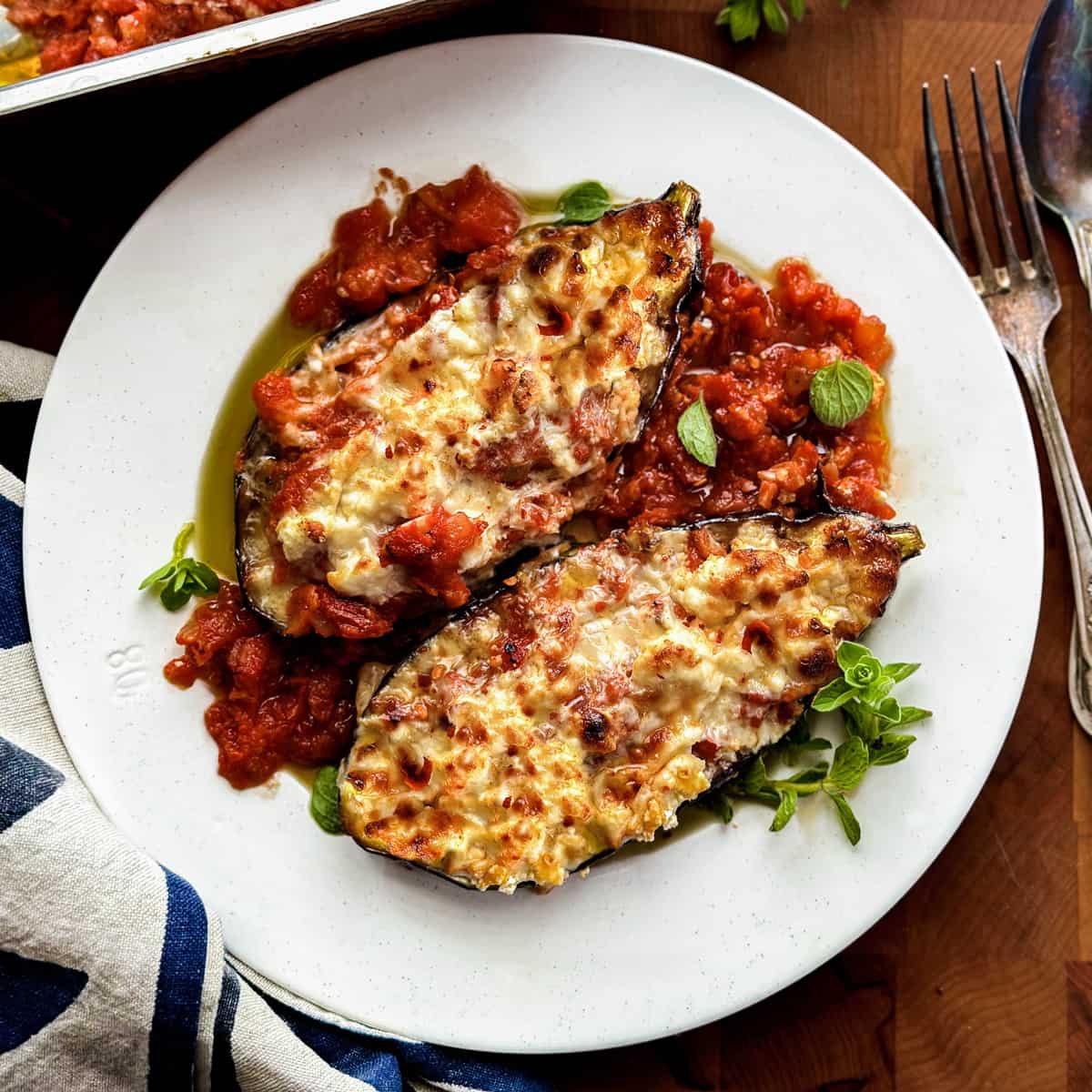
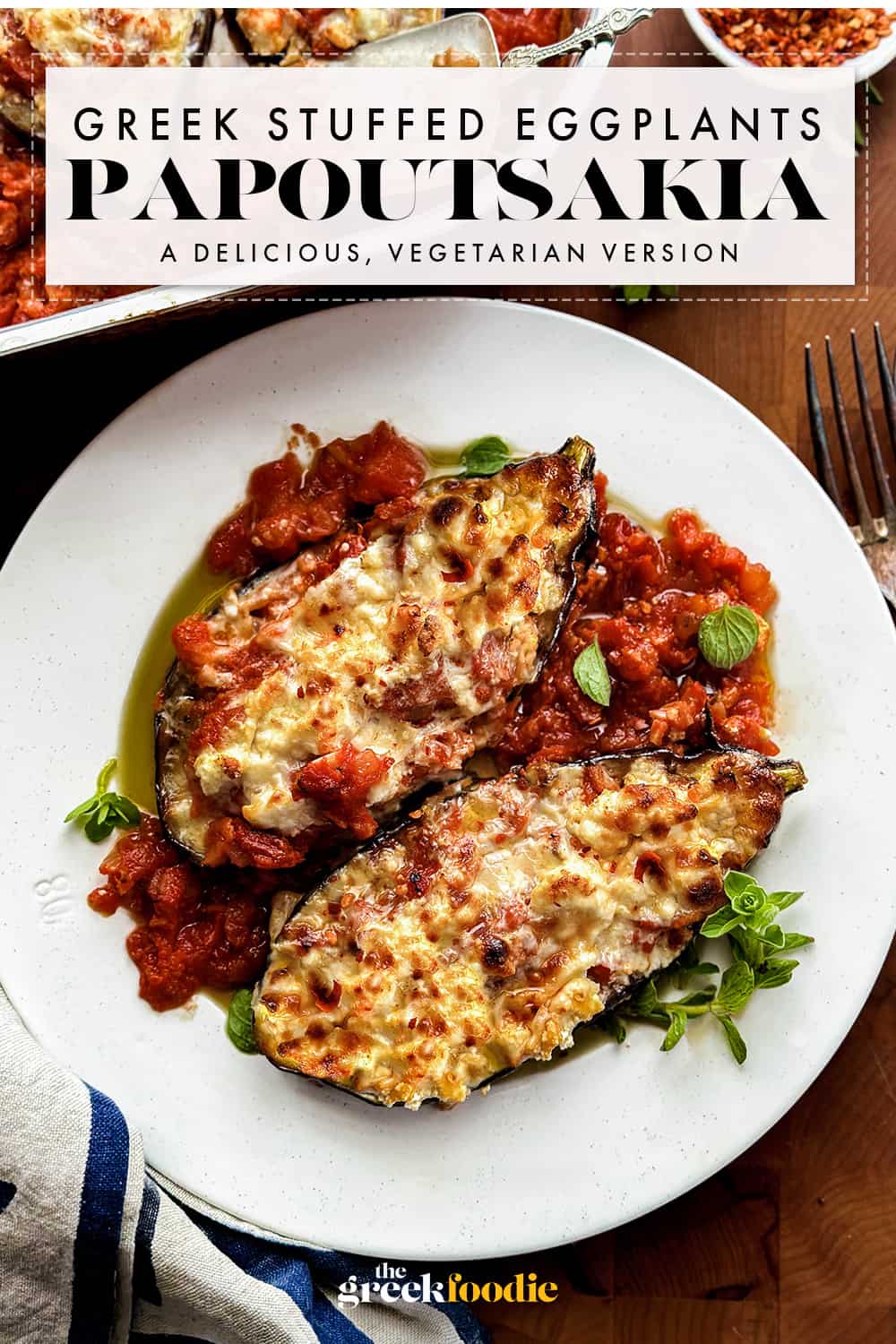
Papoutsakia-Greek stuffed eggplants are a classic for a reason. This spectacular meatless version layers tender roasted eggplants with a hearty tomato sauce, finished with a luxurious, creamy béchamel and melted cheese. Comforting, rich, and unapologetically Greek, it’s the kind of dish that feels special without being fussy.
If you love Papoutsakia-Greek Stuffed Eggplants, you will also love these Gigantes Plaki-Giant Beans in Tomato Sauce, Greek Beef Ragú Pasta-Makaronia me Kima andClassic Roasted Lemon Chicken & potatoes!

Why you will love papoutsakia
A quick note on the sauce: a kind reader rightly pointed out that classic béchamel is made with a white roux and milk, and that adding cheese technically turns it into a Mornay sauce. They’re absolutely correct. That said, Greek home cooks traditionally refer to this white sauce simply as béchamel, so I’ve chosen to keep the name as it’s commonly used in Greek kitchens.
Here is what you need
For the eggplants and tomato sauce

- Eggplants – Choose medium to large eggplants with smooth, glossy skin. Pre-baking softens the flesh and brings out their natural sweetness, which anchors the entire dish.
- Tomatoes – Use good-quality whole tomatoes. When in season, you can use ripe, juicy Roma tomatoes. Year-round, I love canned authentic San Marzano DOP tomatoes such as Gustarosso. Their natural sweetness and low acidity create a rich, balanced sauce. They can be costly, and don’t fit every budget, so regular canned tomatoes will work fine. Add a teaspoon of sugar to the sauce to neutralize its acidity.
- Bay leaf, cloves, and a cinnamon stick – A classic trio in Greek tomato sauces. Bay leaf adds gentle bitterness, cloves bring warmth and intensity, and cinnamon lends a subtle sweetness with woody, slightly citrusy notes.
- Feta cheese – A small crumble is scattered over the eggplants before adding the béchamel. Its tanginess cuts through the creamy sauce and pairs perfectly with the sweet tomatoes and eggplants.
- Kefalotiri cheese – This salty, semi-hard Greek cheese is commonly used in dishes like moussaka, pastitsio, and giouvetsi. If unavailable, grated Parmesan or Pecorino Romano make good substitutes.
- Extra virgin olive oil – Use a good-quality olive oil, as it flavors both the sauce and the eggplants.
- Onion, garlic, sea salt, freshly ground pepper, and dried oregano.
For the béchamel sauce

- Butter. Use good-quality unsalted butter so you can control the salt level, especially since the cheese added later is naturally salty.
- All-purpose flour. Forms the base of the roux. Keep a little extra on hand in case the sauce needs thickening.
- Whole milk. Whole milk gives the béchamel its classic richness. As with the flour, having a little extra allows you to loosen the sauce if needed.
- Nutmeg, a bay leaf, sea salt, and freshly ground pepper. Nutmeg adds a warm, nutty sweetness, while the bay leaf gently perfumes the milk with a subtle bitterness. Season carefully, especially before adding the cheese.
- Kefalotiri cheese. A salty, semi-hard Greek cheese that melts beautifully into the sauce. Season the béchamel only after the cheese is incorporated. Grated Parmesan or Pecorino Romano are good substitutes, and the same seasoning tip applies.
- One egg. Adding an egg helps the béchamel set more firmly on top of the eggplants as it bakes. The dish works well without it, too, for a softer, creamier finish.
Step by step

Step 1: Cut eggplants in half lengthwise, and make some cuts at the flesh crosswise with a sharp knife, carefully not to cut the skin. Sprinkle 2-3 tbsp olive oil all over the eggplants, and season with sea salt, freshly ground pepper, and a pinch of oregano.

Step 2: Place eggplants on a parchment paper-lined baking sheet, facing down, and bake for 30 minutes or until the flesh is soft.

Step 3: With a fork, lightly tease the eggplant flesh. Remove about one tablespoon of flesh from each eggplant. Make sure not to take too much flesh out.

Step 4: Chop the onions and garlic. Place a deep saucepan on high heat and add 2 tbsp olive oil. Add the onion, garlic, cinnamon stick, bay leaf, cloves, a generous pinch of dried oregano, sea salt, and freshly ground pepper. Stir and saute for two to three minutes. Add the tomatoes, stir, and simmer on low heat for 15-20 minutes—season with sea salt and freshly ground pepper to taste. Remove from the heat and set aside.
Add the eggplant flesh to the sauce to your tomato sauce.

Step 7: Fill the eggplants evenly with about two tablespoons of tomato sauce. Add leftover sauce around the eggplants.

Step 8: Add the crumbled feta cheese.

Step 9: Top eggplants with at least two tablespoons of béchamel sauce. Sprinkle over the rest of the grated cheese. Add a pinch of chili flakes all over if you like.
Bake for 45 minutes or until the top is golden in color.

Step 10: Serve warm, straight from the oven, when the béchamel is still soft and creamy.
Pro Tip
Start assembling the dish before making the béchamel. White sauces don’t like to sit around, they form a thin, crusty film on top. Making the béchamel last lets you spoon it over the eggplants right away while it’s smooth, hot, and creamy.

FAQs

Serving Suggestions
- For a fuller spread, serve alongside roasted lemon potatoes, or a pilafi-rice.
- Pair with a Greek village salad (horiatiki) or a simple green salad with lemon and olive oil.
- Add crusty peasant bread on the side for scooping up the tomato sauce and béchamel.
Storage & Reheating
- Refrigerate leftovers in an airtight container for up to 3 days.
- Keep covered to prevent the béchamel from drying out.
- Reheat in the oven (best method) at 170°C / 340°F, loosely covered with foil. Warm until heated through, about 15–20 minutes. Remove foil for the last few minutes if you want the top to be lightly golden again.
- Reheat individual portions in the microwave on medium power to avoid splitting the béchamel. Heat in short intervals, covering loosely.
- Freeze before baking with the béchamel for the best texture. Assemble the eggplants with the tomato filling, cool completely, then wrap tightly and freeze for up to 2 months. Thaw overnight in the refrigerator, add freshly made béchamel, and bake as directed.
- Fully baked papoutsakia can be frozen, but the béchamel may soften slightly when reheated. Thaw overnight and reheat gently in the oven, covered.

Cooked it? Rate it!
If you tried this recipe, I’d love to know how you liked it — drop a comment below or tag me on Instagram @thegreekfoodie__.



Papoutsakia – Greek Stuffed eggplants
Equipment
- Rimmed baking sheet
- Parchment paper
- Large size saucepan
- Medium size saucepan
- baking pan
Ingredients
For the eggplants
- 2 large eggplants, cut in half
For the tomato sauce
- 1 onion , diced
- 3 garlic cloves, minced
- 28 oz crushed tomatoes
- 1 bay leaf
- 2 cloves
- 1 cinnamon stick
for the bechamel
- 3 tablespoons butter
- 1/3 cup all purpose flour, plus more you need to thicken the sauce.
- 1 cup whole milk , plus more you need to loosen the sauce.
- 1 teaspoon grated nutmeg
- 1 egg
- 1 cup kefalotiri cheese, grated
You also need
- ½ cup extra virgin olive oil, total
- 1/2 cup feta cheese, crumbled
- sea salt
- freshly ground pepper
- dried oregano
Instructions
Prepare the eggplants
- Preheat the oven to 175°C / 350°F.
- Cut the eggplants in half lengthwise, and make some cuts at the flesh crosswise with a sharp knife carefully to not cut the skin.
- Sprinkle about 2-3 tbsp olive oil all over the eggplants, season with sea salt and pepper and a pinch of oregano.Place them on a parchment paper-lined baking sheet flesh facing down and bake for 30 minutes or until the flesh is soft.
- Remove from the oven and transfer to a baking pan with the skin down.
Make the tomato sauce
- Place a saucepan on high heat, and add two tablespoons of olive oil. Add the onion, garlic, a generous pinch of oregano, the bay leaf, and cinnamon stick, and saute for 2-3 minutes.
- Add the crushed tomatoes, season with sea salt and pepper, stir and simmer on low heat for 15-20 minutes.
- Remove from heat and set aside.
- With a fork, lightly tease the flesh of the eggplants. Remove some of the flesh, about one tablespoon, from each eggplant. Create a hollow space—that's where you will add the filling.Be careful not to remove too much flesh.Add the eggplant flesh to your tomato sauce and stir.
Start assembling
- Place the eggplants in a baking pan.Fill them evenly with about two tablespoons of tomato sauce. Sprinkle over some crumbled feta cheese. Add leftover tomato sauce around the eggplants.
Make the béchamel
- In a saucepan, warm the milk with the bay leaf.
- In another saucepan, on medium heat, add the butter and stir with a whisk or a wooden spoon until the butter melts.
- Add the flour in batches. Keep stirring to create a "roux."
- Discard the bay leaf from the milk. Gradually add the milk to the roux while stirring vigorously to avoid lumps from the flour.
- As soon as the mixture begins to thicken and the sauce is smooth and has a nice, not-too-thick texture remove from heat. Add the ground nutmeg and ¾ cup of grated kefalotiri. Keep whisking, and add the egg, freshly ground pepper, and one teaspoon of ground nutmeg. Taste the sauce and season with sea salt if needed.
Finish assembling and bake
- Top eggplants with at least two tablespoons of bechamel sauce. Sprinkle the rest of the grated kefalotiri on top of the béchamel. Add a pinch of chili flakes all over if you like. Bake for 45 minutes at 180°C / 390°F or until the top develops a nice golden color.
- Serve immediately with a green salad and warm bread to dip in the sauce.
Notes
- Shortcut option: For faster results, use a good-quality marinara sauce to top the eggplants.
- No béchamel? No problem. Skip it and crumble feta over the tomato sauce instead. The salty feta pairs beautifully with the sweet eggplants and tomatoes and still makes a satisfying dish.
- Cheese swaps: Kefalotyri can be replaced with Parmesan or Pecorino Romano. In a pinch, any hard grating cheese like Manchego or Asiago will work.
- Best tomatoes: Use canned whole San Marzano tomatoes when not in season. Crush them by hand for a rustic texture.
- Avoid smooth tomato sauce: This dish needs chunky tomatoes. A sauce that’s too smooth or watery won’t hold up with the eggplants, béchamel, and cheese
Nutrition
I’m always looking for new eggplant recipes, and I’d never heard of this before now! Fantastic flavour combinations, and wonderfully clear instructions. Great stuff, and a great way to really highlight summer vegetables!
Thank you so much Sean!
This is a GREAT recipe! So easy and delicious. I can’t tell you how much I look forward to eating this. I love eggplant in every way, but this is one of my favorites. Thanks for sharing!
Thank you so much Paula!
Omg this recipe is perfect! Even my fussy son loves it!
Its filling, comforting and rather light!
Your instructions made it a breeze to follow!
Love it!! Thank you!
Thank you so much Lily! So glad you liked them!
What a genius idea… to stuff eggplants! I can’t wait to throw these in my oven and then stuff them in my mouth. What a delicious and healthy dinner recipe.
Thank you Jacque!
I am a lover of all things eggpant yet I had never heard of this fantastic recipe before! I must absolutely make it, as I love everything about it!
Thank you Eva! Hope you like it!
We are always looking for yummy meatless dinners! This one is perfect since I never know what to do do with the eggplants we get from our CSA.
Perfect recipe to try when extra eggplants are around 🙂 Thank you so much Pam!
These look so tasty and filling! What a great vegetarian option
Thank you so much Marwin
Ohhh my goodness this looks like heaven and I just want to dive right in! I LOVE eggplant…saving this recipe to make soon!
We Italians love our eggplant dishes too! This papoutsakia is beautiful cheesy goodness and would be greatly appreciated at our table. Thanks for sharing!
Thank you so much!
Everything about this is just amazing! This is truly a great recipe in every way!
Thank you so much!
What a wonderful meatless main dish to serve anybody… Hearty and delicious thank you!
Thank you so much Chandice!
Loving the step-by-step pics in this recipe! Definitely perfect for a meatless Monday in my house! Thank you so much for sharing!!!
Thank you so much Lori!
Took a trip to Greece like year and I’m now officially obsessed with Greek food. I just love everything! Eggplants sound so yum right now
Greeks sure love to cook and eat! Thank you so much Coralia!
I made this for my husband’s birthday and it quickly became part of our cooking rotation after that. We probably make this once a month or so and it’s delicious every time! We use almond milk instead of cow milk in our house and the bechamel still turns out great!
Thank you so much, Bryn! It makes me very happy to know you like it and make it often. You made my day! x
Amazing recipe! It’s in the oven right now and can’t wait for it to be ready.. it smells absolutely delicious! Great and easy to follow instructions too. Thanks for sharing!
Thanks so much, Linda! You made my day!
Hi, I have tried a few of your recipe and they are simple to make and very delicious…I’m french from Québec Canada and always loved different cultured food.
I would love for you to give us more recipe with eggplants…they are sooooooooo delicious.
I will try to make this recipe and I’m convinced that it will be a hit, like always….
Thank you for sharing your secrets with us !
Hi Manon! You are so sweet, and you made my day with your comment. I love eggplant too, promise to post more recipes with this delicious vegetable.
Thank you so much! x Jenny
Hello – Just making this and liking the whole application. Problem is that during the bechamel process you are not mentioning adding the flour.
The flour is mentioned in the ingredients but nowhere else in the process.
I know to make a roux while making bechamel, but others might not.
You should probably update to add that to the process.
Another comment in terms of the written recipe. Classic béchamel is white roux and milk. Adding cheese makes this a Mornay or a white cheese sauce IMHO.
So vegetarian eggplant papoutsakia with mornay sauce.
Excellent recipe, otherwise once the instructions for the sauce are corrected to add the flour to the roux process and properly calling out the type of sauce used.
Those are an excellent suggestions; I will implement both in the post. Thank you so much, Raymond! x Jenny
how many ounces are in one serving it for a class
Hi Dali,
A large eggplant is about 17 ounces. Each serving has half an eggplant, tomato sauce, and bechamel sauce.
So, you can calculate 8.5 ounces for the eggplant, 4 ounces or half a cup for the sauce, and another 4 ounces or half for the bechamel. Keep in mind that all measurements are approximate.
Thank you so much for checking out the recipe! x Jenny
This eggplant bake is such a fun and exciting way to try a new vegetable — well, new to my kids, not new to me, haha! I think they will absolutely love the flavors and the creaminess of the bechamel sauce. Thank you for sharing this lovely recipe!
The method recipe and the recipe card are different. The recipe card says remove 1 teaspoon of eggplant flesh to add to the tomato sauce, whereas the method recipe says 1 tablespoon.
Also, the egg addition is omitted from the bechamel sauce on the recipe card.
Otherwise, this looks great and I’ll be making it.
Hi Wayde,
You are right and thank you for catching that. We need to fix these errors asap. This dish si so good, hope you make it! x Jenny