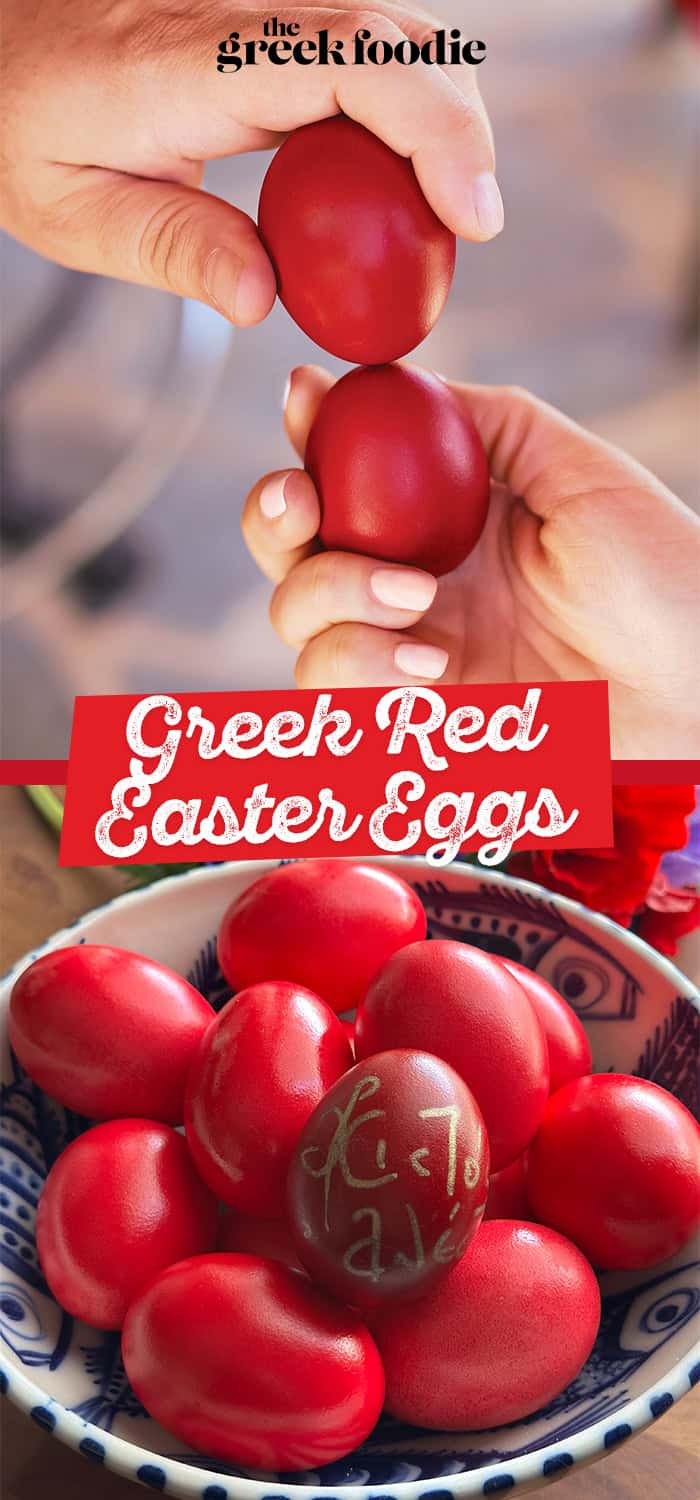

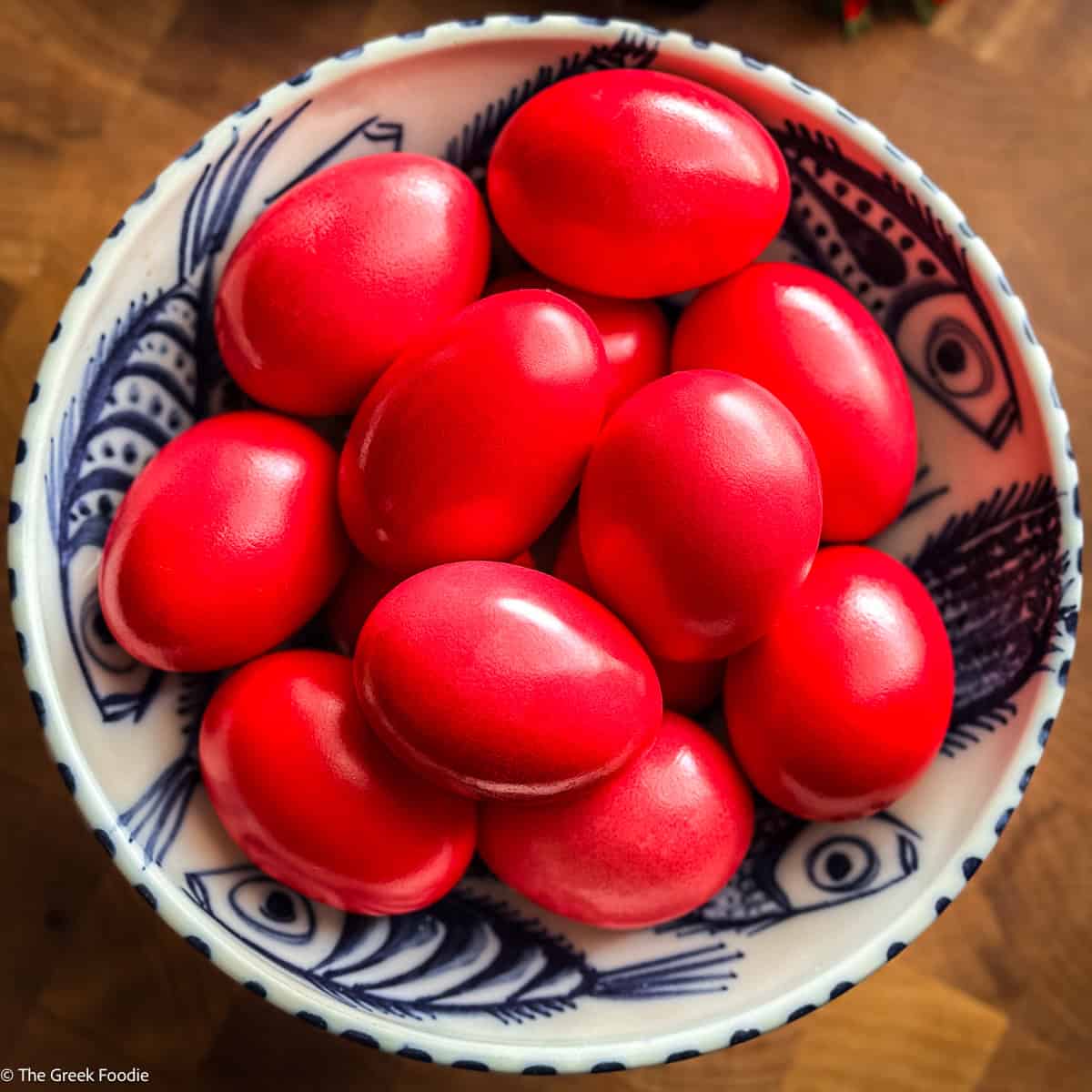
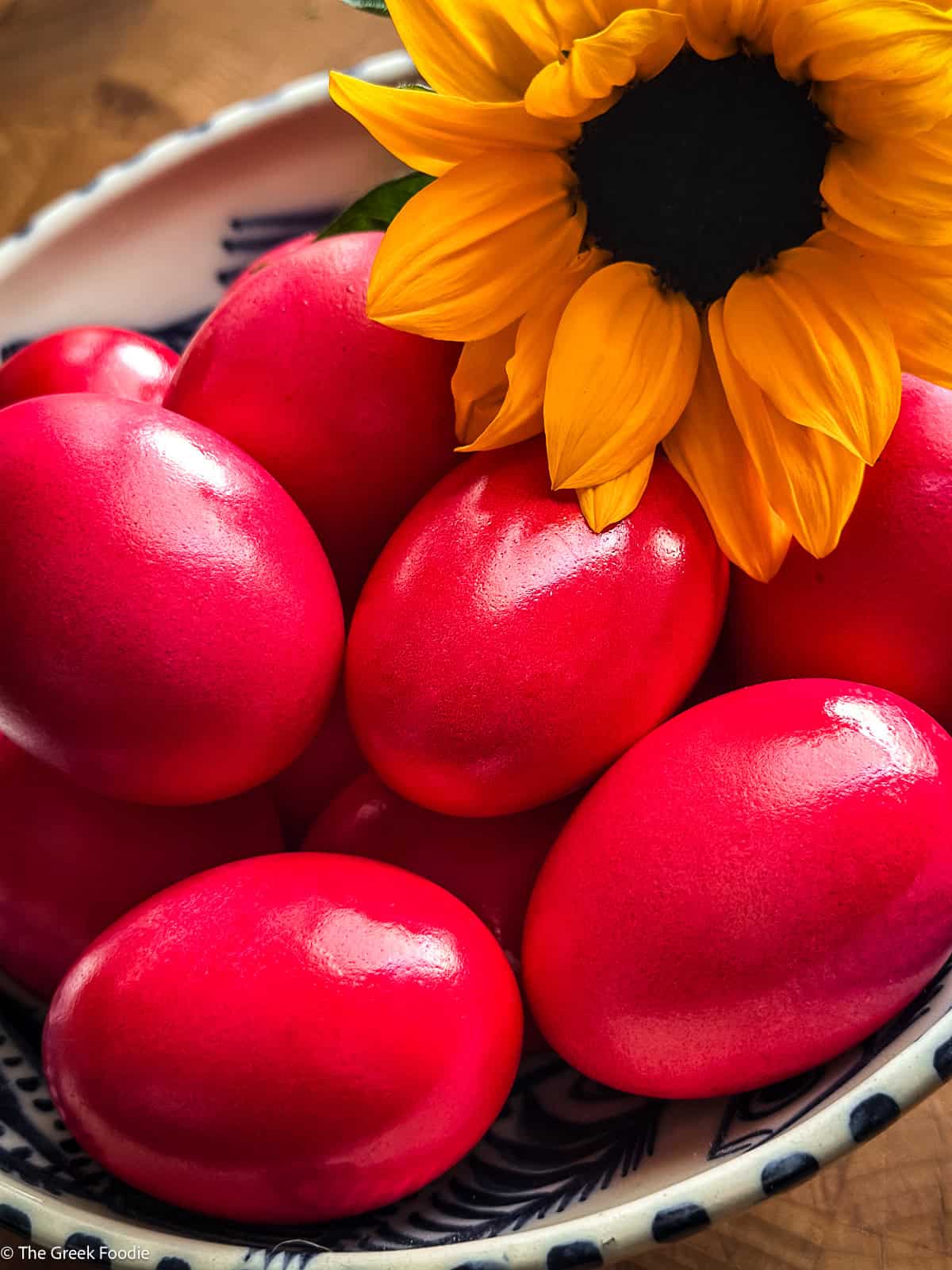
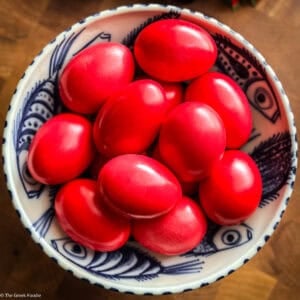
Greek red Easter eggs κόκκινα αυγά (kokkina avga) are the one thing that makes the Greek Easter table instantly recognisable anywhere in the world. A bowl of deep crimson eggs — shining, polished, impossibly red, and they are far more than a decoration. They are what every Greek child learns to crack at the table — because whoever cracks the other person’s egg without breaking their own will have a year of good luck.
In this guide, I am going to tell you everything. The real meaning behind the red, the Orthodox tradition that goes back centuries, the step-by-step method for dyeing them at home (both the traditional way and the natural way), the rules of the egg-cracking game, and every tip I have learned from years of making them in a Greek kitchen.
Planning your Greek Easter menu? Don’t miss our full guide to Greek Easter Recipes — from the lamb on the spit to tsoureki, mageiritsa, and everything in between for the perfect Easter table.
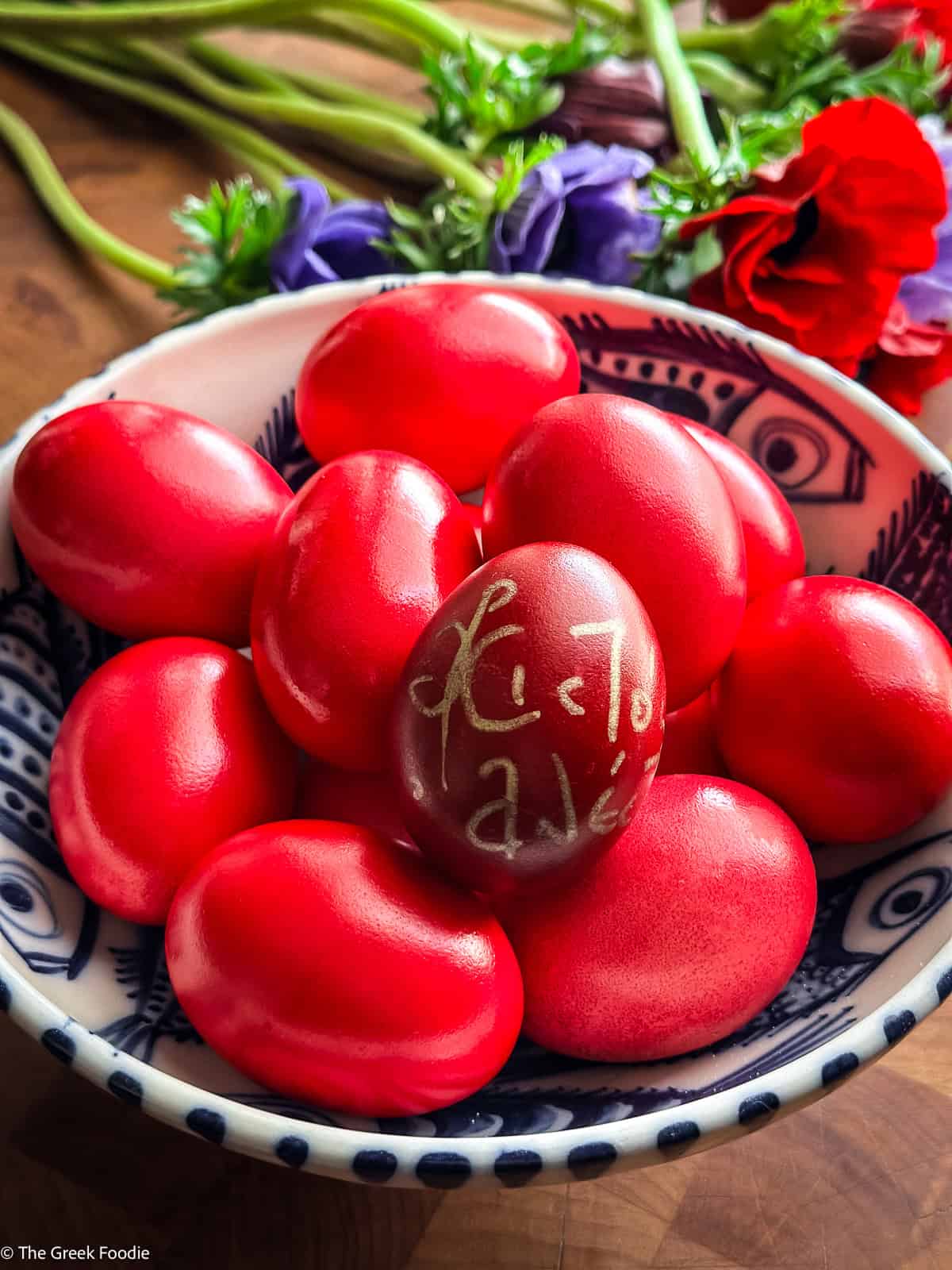
Why are Greek Easter eggs red?
The short answer is this: the red represents the blood of Jesus Christ, shed at the Crucifixion. The egg itself represents the sealed tomb, and the cracking of the egg represents the Resurrection, the breaking open of death itself.
But there is more to it than that. In the Orthodox Christian tradition, the egg has always been a potent symbol of new life, a creature that appears lifeless yet holds life within it. Dyeing it red transforms it into something explicitly sacred: a reminder that new life comes through sacrifice.
According to a beloved Greek folk tradition, Mary Magdalene was the first to dye eggs red. When she learned of the Resurrection and went to share the news, she was carrying a basket of white eggs. As she proclaimed Christos Anesti (Christ is Risen), the eggs turned red in her hands. This story — not canonical but deeply beloved — explains why the colour must be red, and only red.
Other Easter traditions around the world use many colours and patterns. In Greece, especially in the Greek Orthodox tradition, the eggs are always, always red. You will occasionally see decorated eggs in modern Greek households, and that is fine for decoration, but the eggs for the Resurrection table are red.
The practice of dyeing eggs red at Easter is found throughout the Orthodox Christian world — Greece, Romania, Bulgaria, Serbia, Russia, Cyprus, and the Greek diaspora worldwide. The earliest written references tie it to Byzantine Christianity, but the symbolic use of eggs at spring festivals almost certainly predates Christianity entirely.
Breaking the Lenten fast on Holy Saturday? The red eggs come out at midnight alongside a steaming bowl of Mushroom Magiritsa — our vegetarian Greek Easter soup made with mixed mushrooms and silky avgolemono. No cream, no offal, all flavor.
Holy Week in a Greek household
Understanding when and how the eggs fit into Greek Easter week helps you appreciate what they mean. Here is the rhythm of a traditional Greek Easter:
Clean Monday (Καθαρή Δευτέρα)
The start of Lent. Seafood, legumes, no meat. The household begins preparing for the long fast.
Holy Thursday (Μεγάλη Πέμπτη)
The traditional day to dye the Easter eggs. The first egg dyed is always kept — it is the “protomayiátiko” egg, considered especially lucky. Many families dye it and place it behind an icon until the following year.
Holy Friday (Μεγάλη Παρασκευή)
A day of mourning and fasting. The Epitaphios procession takes place in every village and city. No festivities — a day of quiet.
Holy Saturday (Μεγάλο Σάββατο)
The day builds toward midnight. The Anastasi service begins at 11 pm. At midnight, the priest declares Χριστός Ανέστη, the church erupts in candlelight — and then the sky erupts too. Every neighbourhood in Greece lets off fireworks at midnight, loud and joyful and completely chaotic. It’s one of the most thrilling sounds in the world if you grew up with it. Then families go home to break the Lenten fast with mayiritsa soup — and the red eggs come out.
Easter Sunday (Κυριακή του Πάσχα)
The lamb goes on the spit at dawn. The red eggs are on the table from morning. The egg-cracking begins. This is the day.
Traditionally, the eggs are dyed on Holy Thursday — Μεγάλη Πέμπτη. The number dyed is always odd (for luck), and the very first egg is the one set aside, often placed by the icon of the Theotokos (Virgin Mary) in the home.
How to dye Greek Easter eggs red — the traditional method
The traditional method uses a bought dye packet — the most popular brands in Greece are Fantis, the red dye you find in every supermarket from Crete to Thessaloniki in the weeks before Easter. It gives a reliably deep, jewel-like red that the natural method can struggle to match in intensity. You will find all the details and measurements in the recipe card below.
- Start with room-temperature eggs. Cold eggs crack in hot water. If your eggs are in the fridge, take them out an hour before. Hard-boil them in a pot of cold water, brought slowly to a boil — 10 minutes from when the water boils. Do not rush this.
- Prepare the dye bath. In a separate bowl or pot wide enough to hold your eggs, dissolve the dye packet in 4 cups of warm water. Add the full cup of white vinegar — this is not optional. The acid is what makes the dye bond to the shell and gives you that deep, saturated colour.
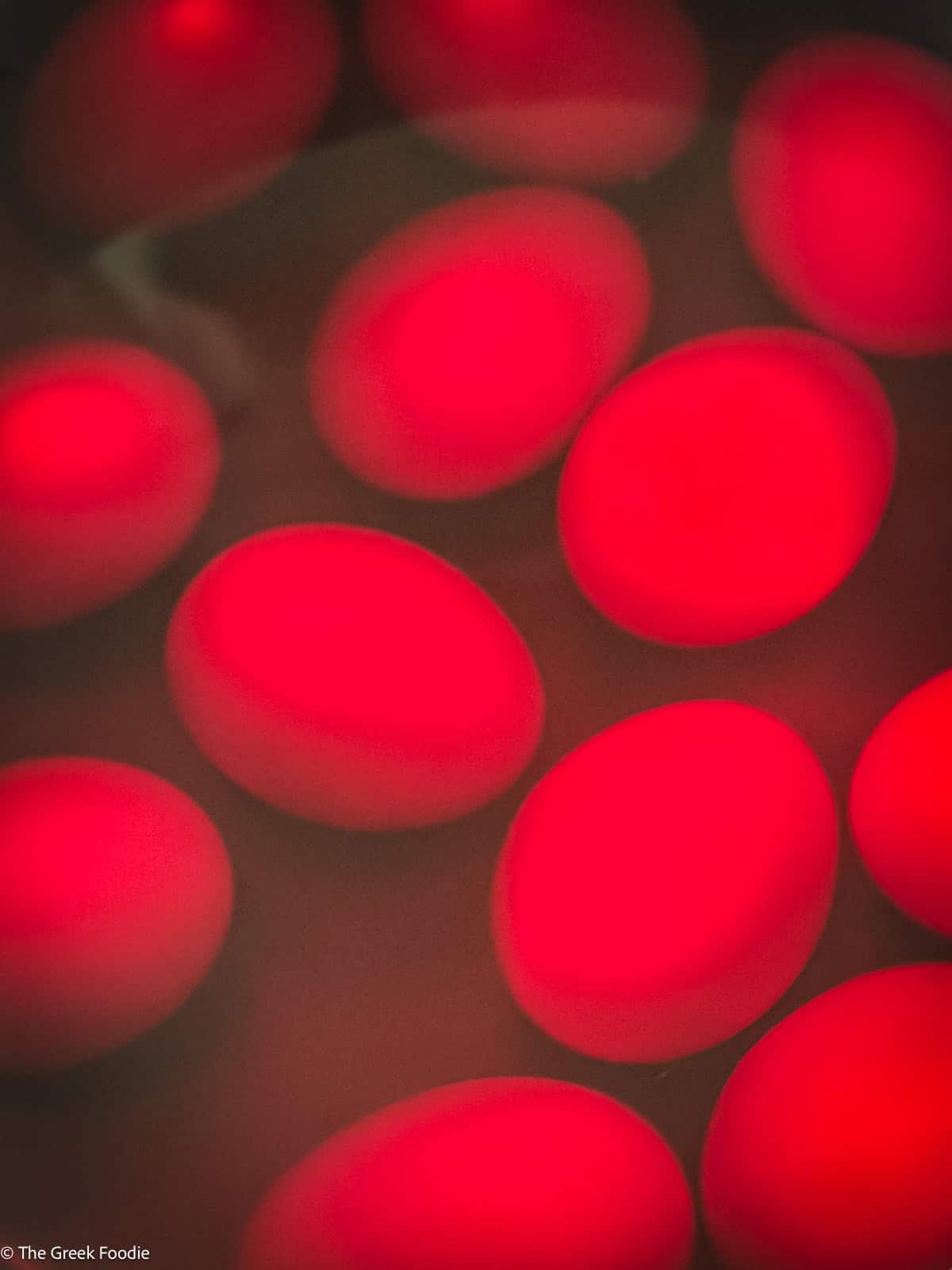
- Dye while warm. Remove eggs from the boiling water and let them cool for just 2–3 minutes — enough to handle, but still warm. Lower them gently, one by one, into the dye bath. Leave for 5–8 minutes, turning every minute or two for an even colour.
- Lift and dry gently. Remove eggs with a slotted spoon onto a paper-towel-lined tray. Pat them dry with a gentle touch — do not rub, or you will streak the colour.
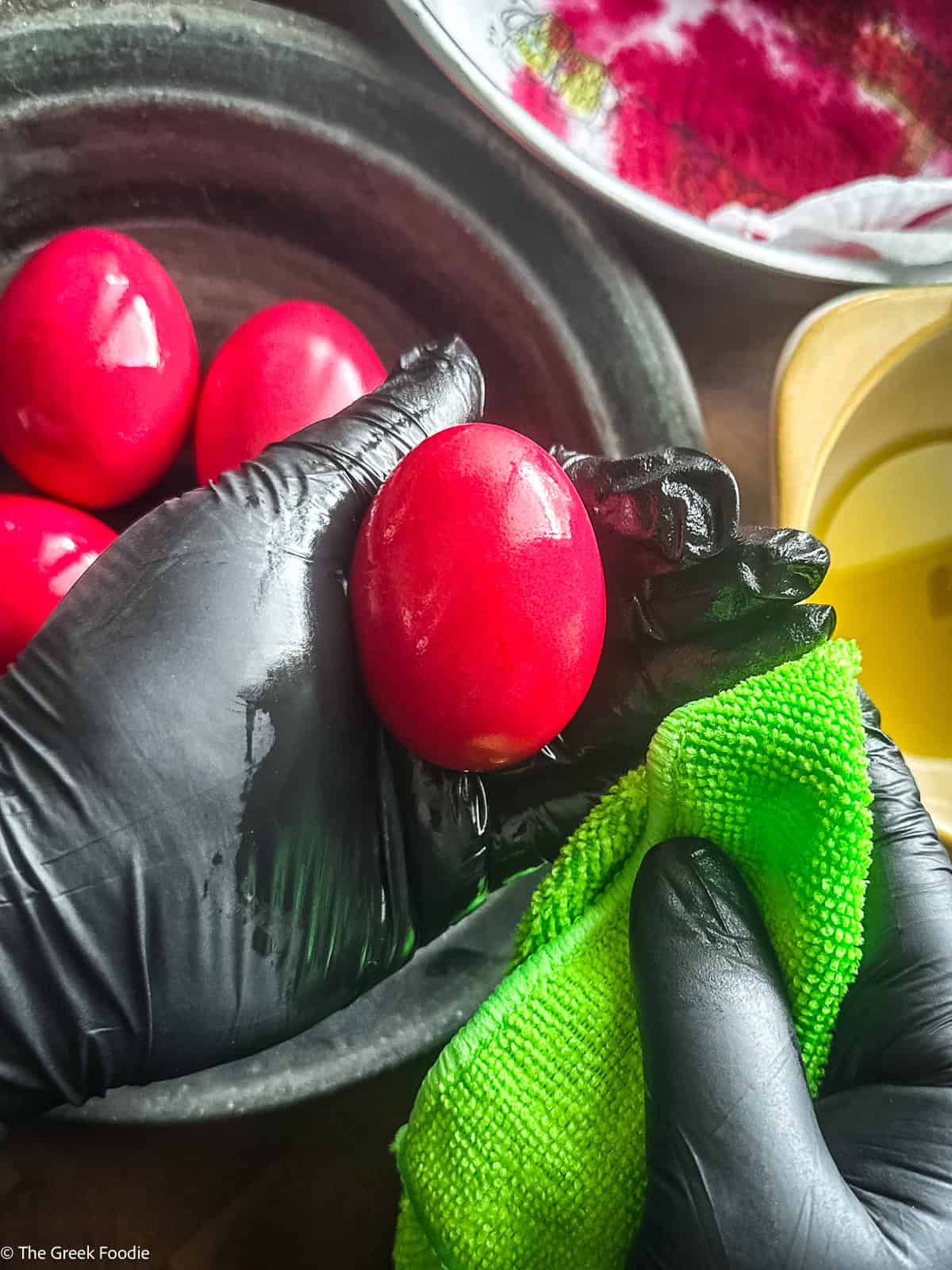
- Polish with olive oil. Once completely dry, pour a few drops of olive oil onto a clean soft cloth and rub each egg until it gleams. This is the step most non-Greeks skip and the Greeks would never miss. It gives the eggs their beautiful, distinctive shine.
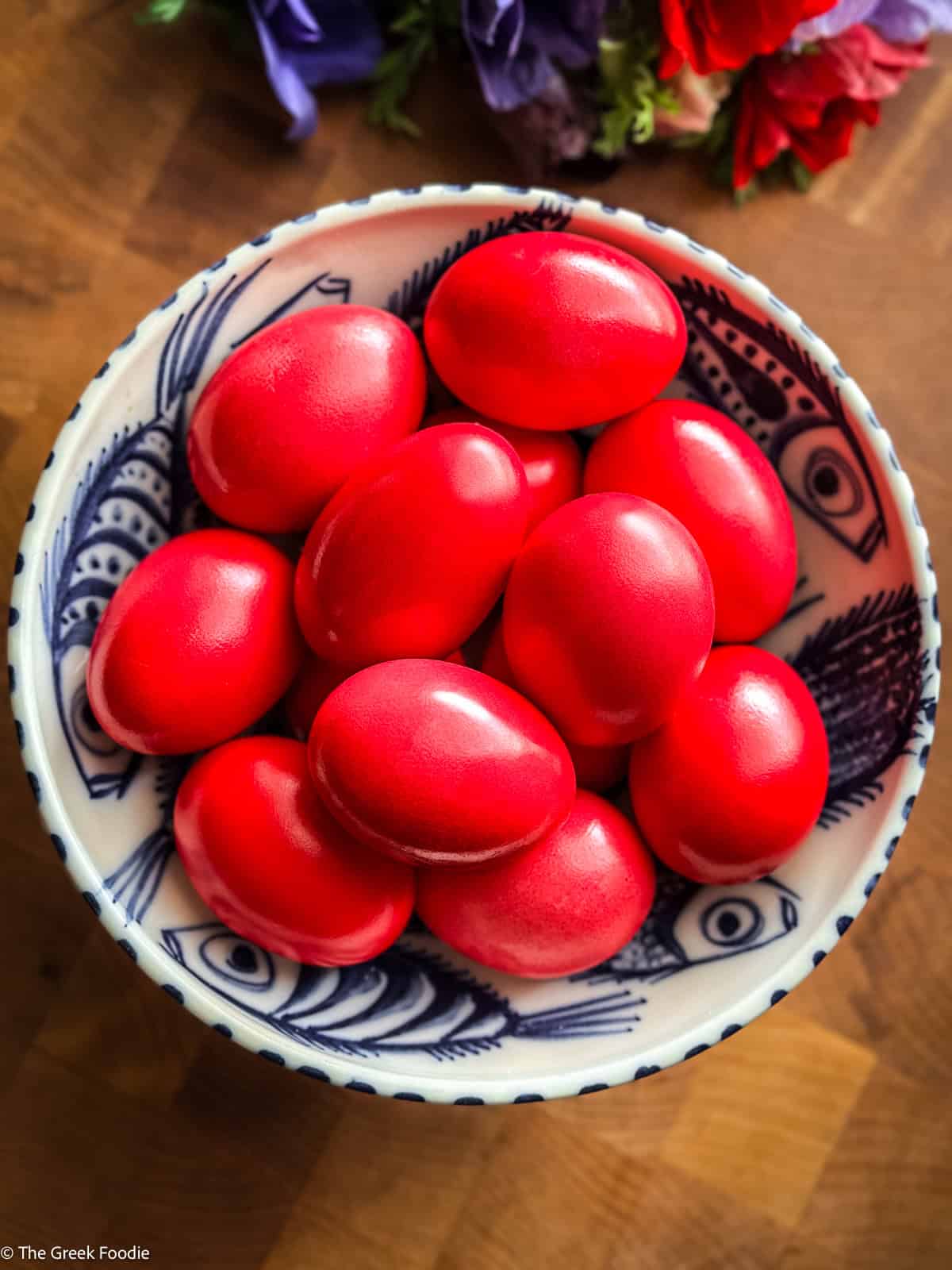
How to dye Greek Easter eggs red naturally — with red onion skins
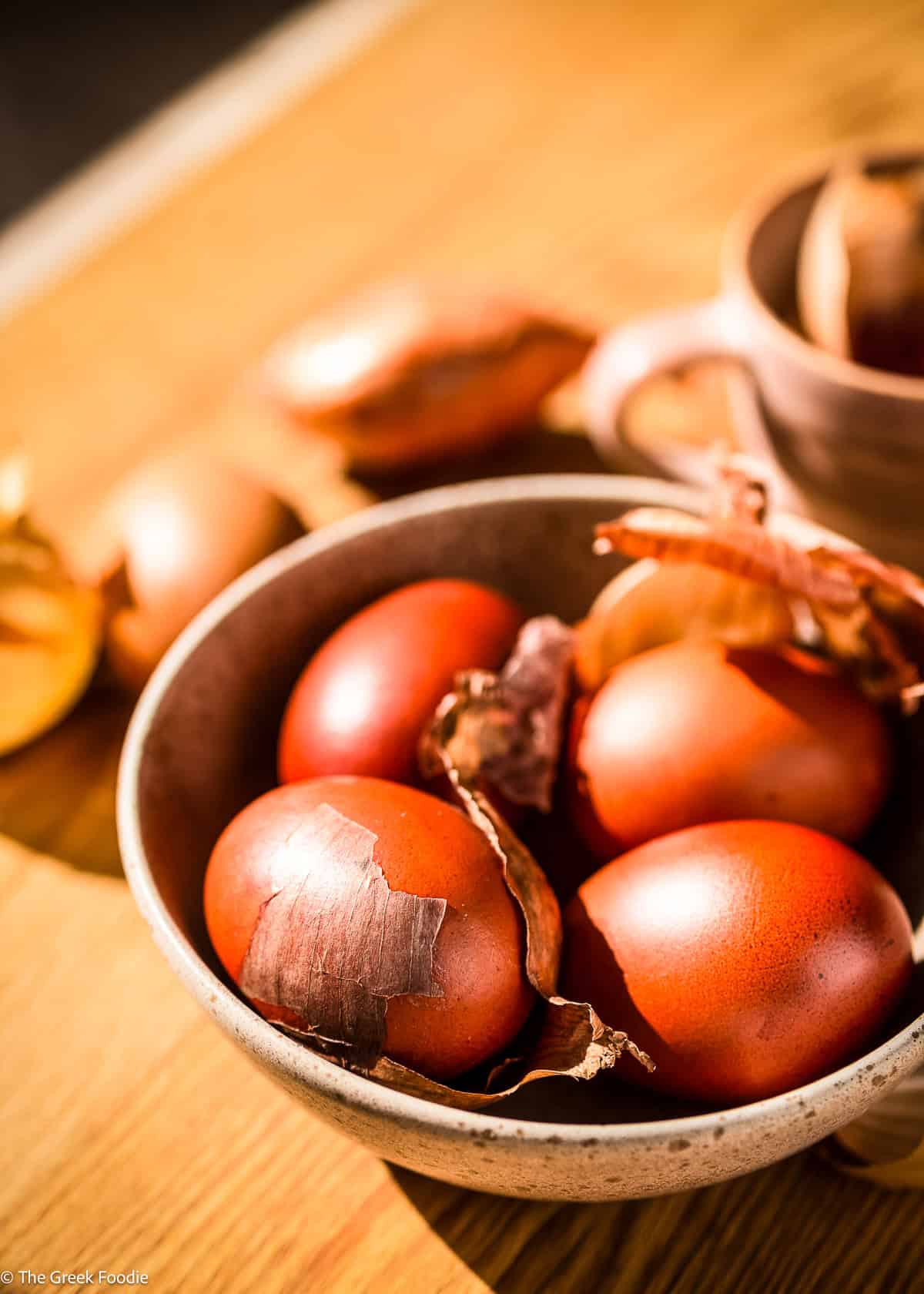
The natural method — using red onion skins — predates the commercial dye packet by centuries and produces a warm, earthy crimson rather than the vivid synthetic red. Some families swear by it; others consider the Fantis packet perfectly fine and considerably faster.
Natural red onion skin method
What You Need
- Outer skins of 8–10 red onions (collect them over a few weeks before Easter)
- 12 white eggs
- 3 tablespoons white vinegar
- Enough water to cover
- Optional: a few sprigs of fresh herbs or leaves to create patterns on the shell
Place the onion skins and eggs in a pot together, cover with cold water, add the vinegar, and bring to a boil. Simmer for 30–40 minutes. The longer they sit, the deeper the colour. Remove, dry, and polish with olive oil as above.
For a lovely pattern effect, press a small herb leaf (flat-leafed parsley or a fern frond works beautifully) against the raw egg, wrap it tightly in a small piece of stocking or gauze, and tie it off before placing it in the dye. When you remove the wrapping, you will have a perfect silhouette of the leaf in the pale colour of the shell against the deep burgundy of the dye. This is an old technique and it still takes people’s breath away at the Easter table.
The egg-cracking game
You have your bowl of perfect red eggs. Now for the best part.
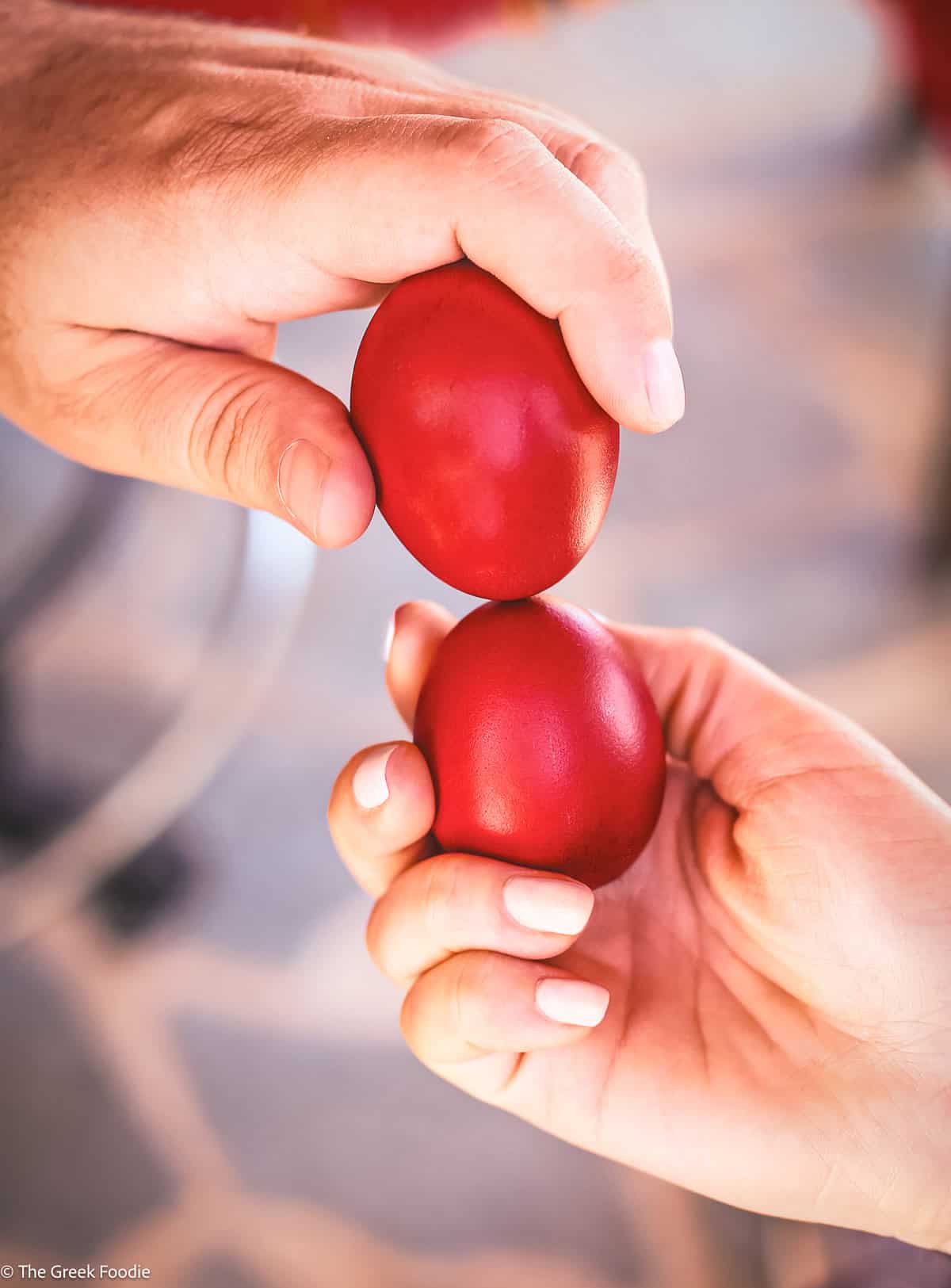
Tsougrisma (τσούγκρισμα) — from the verb tsougrizo (τσουγκρίζω) to clink or strike — is the ritual egg-cracking game played at the Easter table. It is competitive, noisy, slightly political, and absolutely central to the Greek Easter experience.
How to play — the rules
- Each person selects their egg. There is a significant strategy here — you want an egg with a thick, uncracked shell. Some people tap the egg lightly against their teeth first (yes, really) to hear the density. A higher-pitched tap means a stronger shell.
- Two players face each other. One holds their egg tip-pointing up. The other strikes it with the tip of their own egg. One egg will crack.
- The person whose egg cracks turns their egg around and offers the other end (the rounder base). The winner tries to crack that too.
- The winner then moves on to the next person at the table. If your egg survives the whole table intact, you win good luck for the year. If it cracks immediately, you eat it.
The person whose egg survives uncracked throughout the whole table wins good luck for the entire year.
The Great Easter Debate
There is a persistent accusation at every Greek Easter table that someone is using a wooden egg or a hard-boiled egg that has been reinforced in some way. This accusation is almost always directed at the uncle who wins every year. Is it possible? Technically yes. Is anyone actually doing it? Probably not. But the accusation is half the fun.
Χριστός Ανέστη!
Wishing you a table full of good red eggs, a strong cracking arm, and the best Easter yet.
More Greek traditional recipes

Cooked it? Rate it!
Please leave a comment, we love hearing from you! Please subscribe to our newsletter for the latest updates.


Greek Red Easter Eggs
Ingredients
- 12 large white eggs at room temperature
- 1 packet red Easter egg dye (Anatoli, Fantis or equivalent Greek brand)
- 1 cup white vinegar
- 4 cups warm water
- 2 tablespoons olive oil (for polishing)
- Soft cloth or paper towels
Instructions
- Cold eggs crack in hot water. If your eggs are in the fridge, take them out an hour before. Hard-boil them in a pot of cold water, brought slowly to a boil — 10 minutes from when the water boils. Do not rush this.12 large white eggs
- In a separate bowl or pot wide enough to hold your eggs, dissolve the dye packet in 4 cups of warm water. Add the full cup of white vinegar — this is not optional. The acid is what makes the dye bond to the shell and gives you that deep, saturated colour.1 packet red Easter egg dye, 4 cups warm water, 1 cup white vinegar
- Remove eggs from the boiling water and let them cool for just 2–3 minutes — enough to handle, but still warm. Lower them gently, one by one, into the dye bath. Leave for 5–8 minutes, turning every minute or two for an even colour.
- Remove eggs with a slotted spoon onto a paper-towel-lined tray. Pat them dry with a gentle touch — do not rub, or you will streak the colour.
- Once completely dry, pour a few drops of olive oil onto a clean soft cloth and rub each egg until it gleams. This is the step most non-Greeks skip and the Greek yiayiades would never miss. It gives the eggs their beautiful, distinctive shine.2 tablespoons olive oil, Soft cloth or paper towels
Notes
Nutrition