
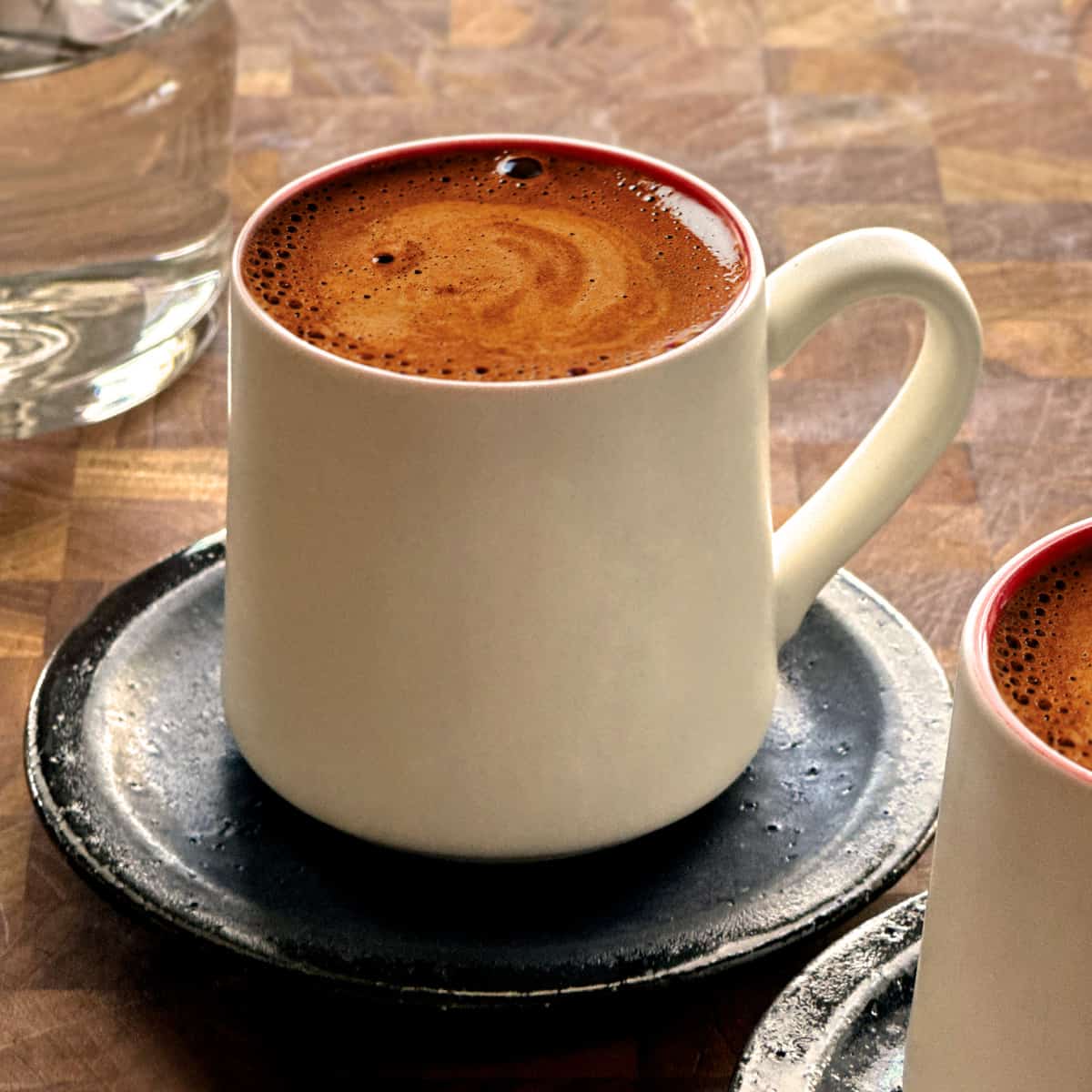
Greek coffee (ellinikos kafes) is a strong, unfiltered coffee made by gently heating very finely ground coffee, water, and optional sugar in a small pot called a briki until a thick foam called kaimaki rises. It’s served in a small cup, grounds and all. You wait a minute for them to settle, then sip.
My grandpa Thanasis took his coffee metrios, always in the late afternoon. When I was with him on the weekends, he’d pour just a little into the saucer and hand it to me to drink. I couldn’t have been more than four or five.
Below I’ll show you exactly how I make it at home. The ratio, the one moment you must pull the briki off the heat, and how to order it like a local.

What is Greek coffee?
Greek coffee is a strong brew prepared with very finely ground coffee beans in a small pot called briki. You don’t drink the strong coffee immediately after serving. One must wait a couple of minutes for the grounds to settle at the bottom of the cup to enjoy the velvety texture.
Greeks drink a lot of coffee and see the whole process as an excuse to meet with a friend, take a long break from work, or just to wake up in the morning. In Athens, every block has at least one café, typically busy and full of people. Although Italian coffee has dominated the industry in recent years, the love for Greek coffee remains strong.
Every home has a briki and small cups with saucers, usually made from thick porcelain to keep the drink hot. In the past, women drank it at home while the men enjoyed the beverage in coffeehouses, kafenia, places of social life and political/sports discussions. In today’s Greece, traditional neighborhood cafes have started to disappear, and specialized coffee shops are everywhere in big cities with customers of all genders and ages. Lattes and macchiatos are everywhere, and homes have fancy espresso machines, yet a briki still sits on almost every Greek stovetop.

Is Greek coffee the same as Turkish coffee?
Yes and no. It’s the same brewing method — Greece learned it during centuries of Ottoman rule, and for generations everyone here simply called it Turkish coffee. The Greeks of Constantinople, Thessaloniki, and northern Greece knew it first; in the 1700s Thessaloniki alone had more than three hundred coffeehouses. The name “Greek coffee” took hold after 1974, when the Turkish invasion of Cyprus made the old name politically uncomfortable — and by the ’90s coffee ads were proudly calling it Greek.

The traditional method for this coffee is to simmer over hot charcoal ashes (hovoli) in a copper pot. Now it is made over the stove, sometimes over a portable gas camping stove many have in their kitchen. That does not mean it can’t be made over any other type. In fact, at home, I make mine over induction.
Differences between Greek and Turkish coffee
It has a different taste, and the consistency is thicker. The method Greeks use to make this coffee differs from the Turkish. It rises once and is served immediately, while the Turkish may be allowed to rise a second and third time before serving. However, the most important difference is the variety of coffee used.
Greek coffee is mainly Brazilian beans, two varieties from Rio and Santos, and Ethiopian beans. The beans roast in a specific process, which makes them blonde. After roasting, they are very finely ground. Greek coffee is blonder than Turkish or Arabic, unflavored (Arabic coffee is often spiced with cardamom), and more concentrated.
*Source: lifo.gr
What you need to make Greek coffee

- Small pot, ideally with a narrow mouth. In Greece, we call it briki. The traditional ones are made of copper. It is not necessary to have a copper pot. Actually, most people use stainless steel or aluminum. Also, a small milk warmer will do the trick. You can find a variety of small coffee pots at Amazon and Greek supermarkets.
- Greek coffee. The beans are ground very finely, like powder. Major brands of this coffee are Loumidis and Bravo, both available at Greek grocers around the US and on Amazon. Don’t use espresso grind — it needs to be powder-fine. Look for packages labeled Greek coffee.
- A demitasse or espresso cup (about 2 fl oz / 60 ml) — it’s also your measuring cup for the water.
- Sugar. This is an optional ingredient.
Greek coffee sweetness guide
| How you order it | Water | Greek coffee | Sugar |
|---|---|---|---|
| Sketos (plain) | ¼ cup / 2 fl oz (60 ml) | 1 heaping tsp | none |
| Me oligi (a little sugar) | ¼ cup / 2 fl oz (60 ml) | 1 heaping tsp | a pinch on the tip of the spoon |
| Metrios (medium) | ¼ cup / 2 fl oz (60 ml) | 1 heaping tsp | ½ tsp |
| Glykos (sweet) | ¼ cup / 2 fl oz (60 ml) | 1 heaping tsp | 1 tsp |
- Single or double? In a Greek café, after asking how sweet you want it, they’ll ask monos or diplos — single or double. A double (diplos) is twice the water and coffee, served in a bigger cup.
- “Making two? Double everything and use a two-cup briki.”
How to make Greek coffee

- Pour 60 ml of water into a small pot with a narrow mouth.
- Add 1 full teaspoon of coffee and sugar, or adjust to your preference.
- Stir until everything is well mixed — some people keep stirring until the coffee starts to warm. Then stop and let the foam rise. Stay right next to the stove: if it boils, it foams up and over the top, and you’ll be cleaning coffee off your stovetop.
- As soon as the foam reaches the top (images 3 and 4), remove the small pot from the heat. Do not let it boil!

Serve the coffee, slowly pouring it into the cup and finishing with the creamy foam on top. The creamy foam is called kaimaki. Greek coffee is considered successful when the kaimaki is preserved during serving.
Don’t drink this hot coffee immediately after serving. Wait a couple of minutes for the grounds to settle to the bottom of the cup before drinking.

Serve Greek coffee with a glass of iced cold water, a couple of pieces of Turkish delight, or cookies.
How to make Greek coffee without a briki
No briki? Use the smallest saucepan or milk pan you own. The foam won’t climb as high in a wide pan, so watch even more closely and pull it the second the foam starts to rise. A small butter warmer works almost as well as the real thing.
What you can’t do is skip the stovetop. A microwave, an espresso machine, or a moka pot won’t give you Greek coffee. It has to be heated slowly in a pot until the foam rises — there is no other way.
What to serve with Greek coffee
Greek coffee always comes with a glass of cold water, and almost always with something small and sweet. Loukoumi is the classic. In winter, it’s the cup I put next to a plate of melomakarona and powdery kourabiedes; at Easter, it’s koulourakia. A slice of karidopita or a square of pistachio baklava never hurt anyone either.

FAQ
More Greek drinks
Cooked it? Rate it!
If you tried this recipe, I’d love to know how you liked it — drop a comment below or tag me on Instagram @thegreekfoodie__.



How To Make Greek Coffee
Equipment
- Briki (small Greek coffee pot),
- Demitasse cup
Ingredients
- ¼ cup 2 fl oz / 60 ml water
- 1 heaping teaspoon Greek coffee, such as Loumidis or Bravo
- 1 teaspoon sugar, optional (see notes)
Instructions
- Pour the water into a briki. Add the coffee and sugar (if using) and stir well until there are no dry lumps.
- Set over medium heat. Keep stirring if you like until the coffee starts to warm, then stop and let it be. Watch as a creamy foam (kaimaki) forms and starts to rise, it'll look like cocoa warming on the stove.
- The second the foam reaches the top of the briki, take it off the heat. Do not let it boil — it will overflow and make a mess of your stove!
- Pour slowly into your cup so the foam lands on top. Let it rest for 1–2 minutes so the grounds settle, then sip. Serve with a glass of cold water.
Notes
- Sketos (plain): no sugar
- Me oligi (a little sugar): a pinch on the tip of the spoon
- Metrios (medium): ½ teaspoon sugar
- Glykos (sweet): 1 teaspoon sugar
- For 2 cups, double everything and use a two-cup briki.
Nutrition