


These Greek Lamb Shanks are pure comfort. Fall-apart tender, richly flavored, and incredibly easy to make. The shanks slow-cook in a red wine broth with garlic, rosemary, sea salt, and vegetables until the meat softens to buttery perfection. It’s the kind of dish that fills the kitchen with the most irresistible aroma and brings everyone straight to the table.
Lamb is not a Greek weeknight food, it’s what comes out for Easter, for name days, for the Sunday when everyone shows up. The pot goes in the oven in the late morning, the house fills with rosemary and wine, and nobody is allowed to lift the lid. That’s the whole method. Time does the work, and you get out of the way.
Most lamb shank recipes you’ll find are French or British in spirit, heavy on stock reductions and butter. This one is Greek: olive oil instead of butter, rosemary and oregano instead of thyme, and a sauce that stays bright rather than glossy-rich.

Why you will love this recipe
How to choose lamb shanks
How many: One shank per person. They look enormous but a lot of that weight is bone. A 12 oz shank yields a generous but not excessive portion. For four people, ask your butcher for four shanks, roughly 3 lbs / 1.4 kg total.
What to look for: Hind shanks are meatier than fore shanks and hold their shape better through a long braise. Look for a good cap of white fat and meat that’s deep pink rather than pale. Avoid anything with a grey cast or dry-looking edges.
Frenched or not: Butchers sometimes trim the top of the bone clean, which looks lovely on the plate. It makes no difference to the cooking. Untrimmed shanks are usually cheaper and taste exactly the same.
Should you trim the fat? Leave it. It renders down during the three hours and carries flavor into the sauce. You’ll skim what you don’t want at the end — see below.
Frozen shanks work perfectly well for this. Thaw them fully in the fridge overnight, then pat them very dry before browning. Wet lamb steams instead of browning, and that first sear is where a lot of the flavor comes from.
If you love these Slow Cooked Lamb Shanks, you will also love our Leg Of Lamb In A Parcel – Kleftiko, Lamb Stew Avgolemono, or Dutch Oven Roast Chicken!
Here is what you need
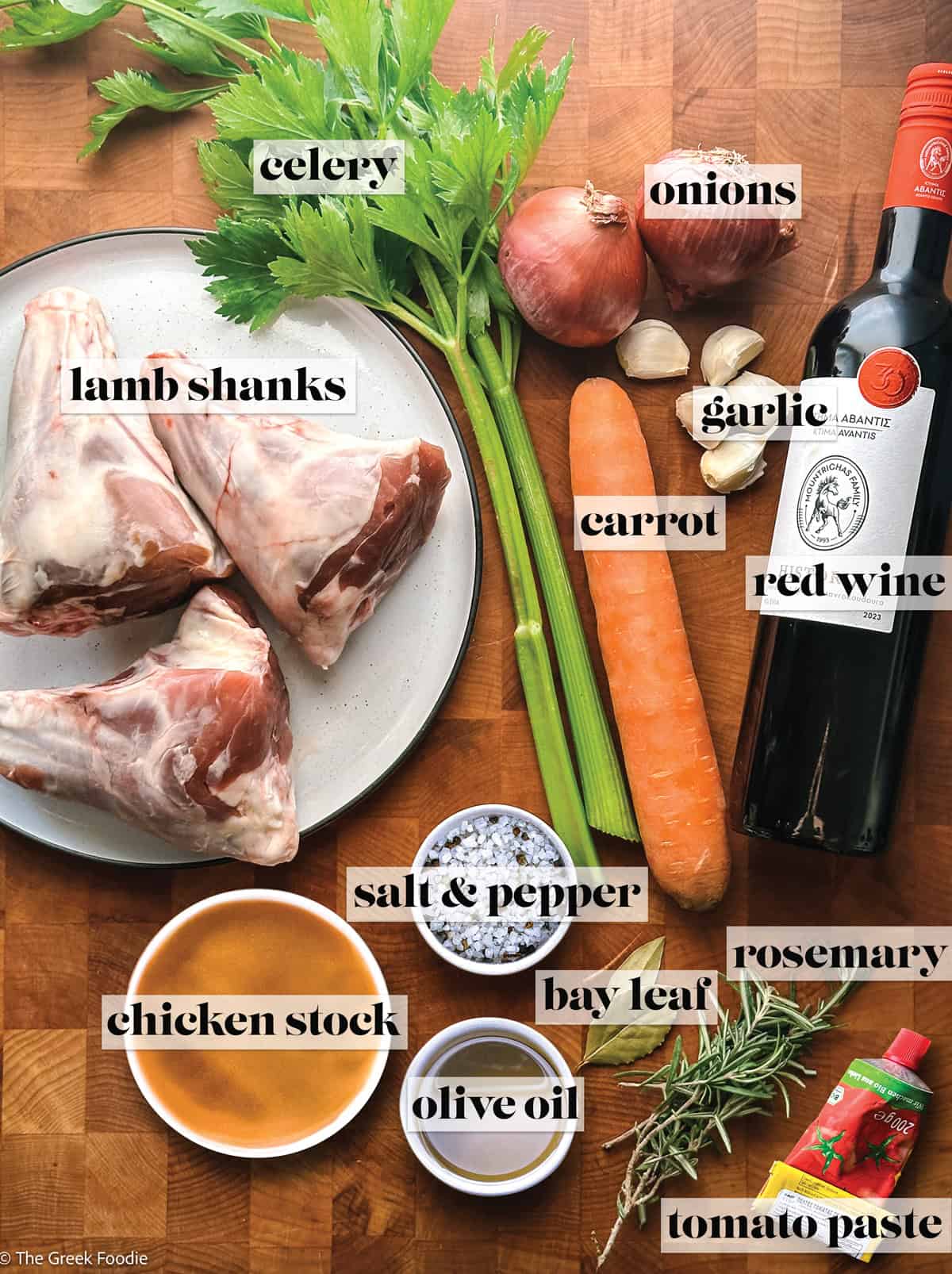
- Lamb shanks – A flavorful cut from the lower leg, rich in collagen and perfect for slow cooking. The meat becomes incredibly tender and falls off the bone.
- Garlic and onion, celery, and carrots – The classic aromatic base that builds deep flavor as the lamb braises.
- Dry red wine – Choose one you enjoy drinking; it reduces into a rich, savory sauce.
- Fresh rosemary – Earthy, aromatic, and essential for that Greek comfort-food vibe.
- Chicken stock – Vegetable stock works just as well if you prefer it.
- Dried oregano (not shown above), bay leaves, sea salt, freshly ground pepper, and extra virgin olive oil – Simple Greek staples that round out the flavor beautifully.
How to make Greek lamb shanks in the oven

Step 1. Brown the Lamb: Season the lamb shanks generously with sea salt, freshly ground pepper, and a sprinkle of dried oregano.
Heat an oven-proof pot over high heat, add a little olive oil, and brown the lamb on all sides until deeply golden. This step builds the base flavor for the entire dish.
Transfer the browned shanks to a plate and carefully discard any excess fat or liquids from the pot.
Preheat the oven to 140°C / 284°F.

Step 2. Build the Flavor Base: Add a little olive oil to the pot. Stir in the onion, garlic, celery, and carrots, and cook for 3–5 minutes until they soften slightly.
Add the tomato paste and cook for 2–3 minutes more, stirring occasionally, to deepen the flavor.
Pour in the red wine and deglaze the pot, scraping up any browned bits from the bottom. Let it cook on high heat for about 3 minutes, just until the alcohol cooks off.

Step 3. Add the Lamb & Braising Liquid: Return the lamb shanks to the pot and pour in the stock. Bring the mixture to a boil, then reduce the heat. Add the rosemary and bay leaves, cover the pot, and transfer it to the oven.

Step 4. Slow-cook the lamb: Cook the shanks, covered, at 140°C / 284°F for about 3 hours.
Don’t go by the clock alone. They’re ready when a fork slides into the thickest part with no resistance and the meat has visibly pulled back from the bone by half an inch or so. If you lift a shank by the bone and the meat sags but holds, that’s the moment. If it still grips the bone, cover it and give it another 30–45 minutes. Lamb shanks are very forgiving — you cannot really overcook them, but you can absolutely undercook them, and that’s the single most common reason a braise disappoints.
Once done, lift the shanks out onto a plate and cover loosely with foil. Strain the braising liquid through a sieve into a saucepan, pressing gently on the vegetables to get everything out of them.
The red wine sauce
The sauce is the point of this dish, so give it five more minutes of attention.
Skim the fat first. Lamb throws a lot of fat, and if you thicken before you skim you’ll end up with something heavy and slick. Let the strained liquid sit for a few minutes and the fat will rise into a clear layer on top, tilt the pan and lift it off with a wide spoon. A fat separator makes it easy. If you have time, chill the liquid and the fat lifts off in one solid sheet.
Then reduce. Boil the skimmed liquid hard over high heat until it coats the back of a spoon. This usually takes 8–12 minutes and concentrates the wine and stock into something properly savory. Taste before you salt — reducing concentrates the salt already in there.
If you want it thicker still: whisk 2 tablespoons of all-purpose flour into ¼ cup of the hot liquid until completely smooth, then pour it back into the simmering sauce while stirring continuously. Cook 4–5 minutes.
Gluten-free: mix 1 tablespoon cornstarch with 2 tablespoons cold water and stir the slurry into the simmering sauce. Cook 1–2 minutes, just until it thickens.
Which wine: any dry red you’d actually drink. If you want to keep it Greek, an Agiorgitiko or a Xinomavro both work beautifully. Xinomavro in particular has the acidity to cut through the fat. Nothing sweet, and nothing you’re saving for the table.

Other ways to cook lamb shanks
Slow cooker
Brown the shanks and build the flavor base exactly as written — don’t skip this and dump everything in raw, you’ll lose most of the depth. Transfer everything to the slow cooker, add the stock, rosemary and bay leaves, and cook on LOW for 7–8 hours or HIGH for 4–5 hours, until the meat falls from the bone.
Slow cookers don’t evaporate liquid the way an oven does, so the sauce will be thinner at the end. Strain it into a saucepan and reduce it on the stove before serving, this step isn’t optional with a slow cooker.
Instant Pot / pressure cooker
Use the sauté function to brown the shanks and cook the vegetables and tomato paste, then deglaze with the wine right in the pot. Return the lamb, add the stock, rosemary and bay leaves, and cook on high pressure for 45 minutes with a 15-minute natural release.
Reduce the sauce on sauté afterwards. Pressure cooking is the fastest route but the sauce won’t have quite the same depth as three hours in the oven — worth knowing before you choose.
Stovetop
Same pot, same steps, just keep it on the lowest possible heat with the lid on for 2½–3 hours. Check every 45 minutes that the liquid hasn’t dropped below halfway up the shanks, and top up with a splash of stock if it has. A heavy pot is essential here or the bottom will scorch.
What to serve with Greek lamb shanks
- Potatoes — You can’t go wrong here. Creamy mashed potatoes make the dish feel like upscale comfort food, and Greek roasted lemon potatoes pair beautifully with the rich wine sauce.
- Rice — Our fragrant Greek pilafi with cranberries, chestnuts, and pine nuts is festive, flavorful, and perfect for soaking up the sauce.
- Bread — A warm loaf of Greek peasant bread is divine for dipping into the braising juices. Simple, rustic, and impossible to resist.
- Salad — A big, crisp traditional Greek lettuce salad cuts through the richness of the lamb. Roasted cauliflower steaks with lemon, olive oil, and capers are another favorite pairing — bright, tangy, and a great contrast to the slow-cooked meat.
- Greek lamb shanks with lemon potatoes. If you only make one pairing, make it this one. Greek roasted lemon potatoes roast at a much higher temperature than the lamb braises, so put them in for the last hour with the lamb on a lower shelf — the oven does double duty and the potatoes come out golden just as the shanks finish. The lemon and oregano cut straight through the richness of the wine sauce, which is exactly what you want. Spoon a little of the reduced sauce over the potatoes at the table.
Make it ahead
These are genuinely better on the second day, which makes them ideal for a dinner party or Easter table.
Cook the dish completely, then cool it and refrigerate the shanks in their unstrained braising liquid — the meat keeps reabsorbing flavor overnight and won’t dry out. The fat sets into a solid layer on top, which you simply lift off before reheating. That’s the easiest fat-skimming you’ll ever do.
To reheat, bring the whole thing back to a gentle simmer on the stove or warm it covered at 150°C / 300°F for about 30 minutes. Then strain and reduce the sauce as usual.
You can prepare it up to two days ahead this way.
Troubleshooting
The meat is still tough. It needs more time, not less. Tough braised lamb is undercooked lamb — the connective tissue hasn’t broken down yet. Cover it and give it another 30–45 minutes, then check again. This is almost always the answer.
The sauce is greasy. You skimmed too early or not enough. Let the strained liquid settle and lift the fat layer off before you reduce. If it’s already reduced and still slick, chill it and remove the solid fat, then rewarm.
The sauce is thin and watery. Reduce it harder. Most people stop too soon, you want it to visibly coat a spoon, not just look darker.
The sauce is too salty. This happens when a salted stock reduces too far. Add a splash of water or unsalted stock and a squeeze of lemon to rebalance.
The meat is dry even though it’s tender. The liquid didn’t come far enough up the shanks, or the oven ran hot. The braising liquid should reach at least halfway up the meat, and 140°C / 284°F is genuinely as high as you want to go.
The shanks won’t fit in one layer. Don’t stack them. Use a wider pot or cook in two batches — crowded shanks steam rather than braise.
Storage and reheating
Slow-cooked lamb shanks keep well, and the flavors deepen overnight.
Storage: Store leftovers in an airtight container in the refrigerator for up to 3 days.
The sauce may thicken as it cools — that’s normal.
Reheating: Warm the lamb gently in a covered pot on low heat or in the oven at 150°C / 300°F until heated through. Add a splash of stock or water if the sauce has thickened too much.
Freezing: Lamb shanks freeze well. Store in freezer-safe containers for up to 3 months. Thaw overnight in the fridge before reheating.

FAQ
You may also like
Cooked it? Rate it!
If you tried this recipe, I’d love to know how you liked it — drop a comment below or tag me on Instagram @thegreekfoodie__.



Greek Lamb Shanks
Equipment
- oven proof pot like a dutch oven
Ingredients
- 4 lamb shanks, (about 3 lbs / 1.4 kg)
- ¼ cup extra virgin olive oil, plus more for browning
- 1 cup onion, roughly chopped
- 1 large carrot, roughly chopped
- 2 celery stalks, roughly chopped
- 2 tablespoons tomato paste
- 5-6 garlic cloves
- ⅔ bottle red wine
- 3 cups chicken stock
- 2 bay leaves
- 3–4 sprigs fresh rosemary
- 1 teaspoon dried oregano
- sea salt
- freshly ground pepper
- 2 tablespoons all-purpose flour, optional
Instructions
- Heat the oven at 140°C / 284°F
- Season the lamb with sea salt and freshly ground pepper and some dried oregano.Place an oven-proof pot over high heat, add olive oil, and sauté the lamb shanks until well browned on all sides. Transfer the lamb to a plate and discard the liquids from the pot.
- Pour in the olive oil. Add the onion, garlic, celery, and carrots. Cook for 3-5 minutes, stirring occasionally. Add the tomato paste and continue to cook for 2-3 minutes, stirring occasionally.Pour in the wine and deglaze the pan, cook on high until alcohol has evaporated, about 3 minutes.
- Return the lamb to the pot, add the stock and bring to a boil. Reduce the heat, add the rosemary and bay leaves, cover the pot, and place it in the oven.
- Cook, covered in the oven at 140°C / 284°F until the lamb is tender and falls off the bone, about 3 hours. Strain the stock through a sieve into a saucepan and boil until the sauce has thickened. See recipe notes for thickening the sauce
Notes
Nutrition


This slow cooked lamb roast was so delicious! It was the perfect Sunday night dinner!
Absolute perfection! So tasty, moist and easy to make. Thanks so much for making look great in the kitchen.
This is the perfect recipe for those that are beginning to roast a lamb leg. Foolproof recipe – LOVE!
Made your lamb for my mom and she loved it. Great recipe, thank you!
That’s great Nancy! Thank you so much!
First time making a roasted lamb, and this is a helpful guideline for me in making it.
So delicious! Thank you!
I’ve never tried lamb before, this will be a new recipe challenge for me!
I hope you like it Andrea! Thank you so much for checking it out!
Lamb is a family favorite, usually we have it for Easter, but decided to whip up your recipe and we all loved it!
I loved how my lamb came out from this recipe. It was so flavorful and tender. Everyone in my house thought it was amazing. I will be making this again!
Thank you for this recipe! We made it tonight and it was so tender and flavorful!
I’ve cooked lamb shanks using many recipes; yours is the most straight forward. Great results with almost no effort. Thank you!
Hi Robert,
Thank you so much for your kind words!
I am very happy with your results, I love this recipe as well and your comment made my day. x Jenny