
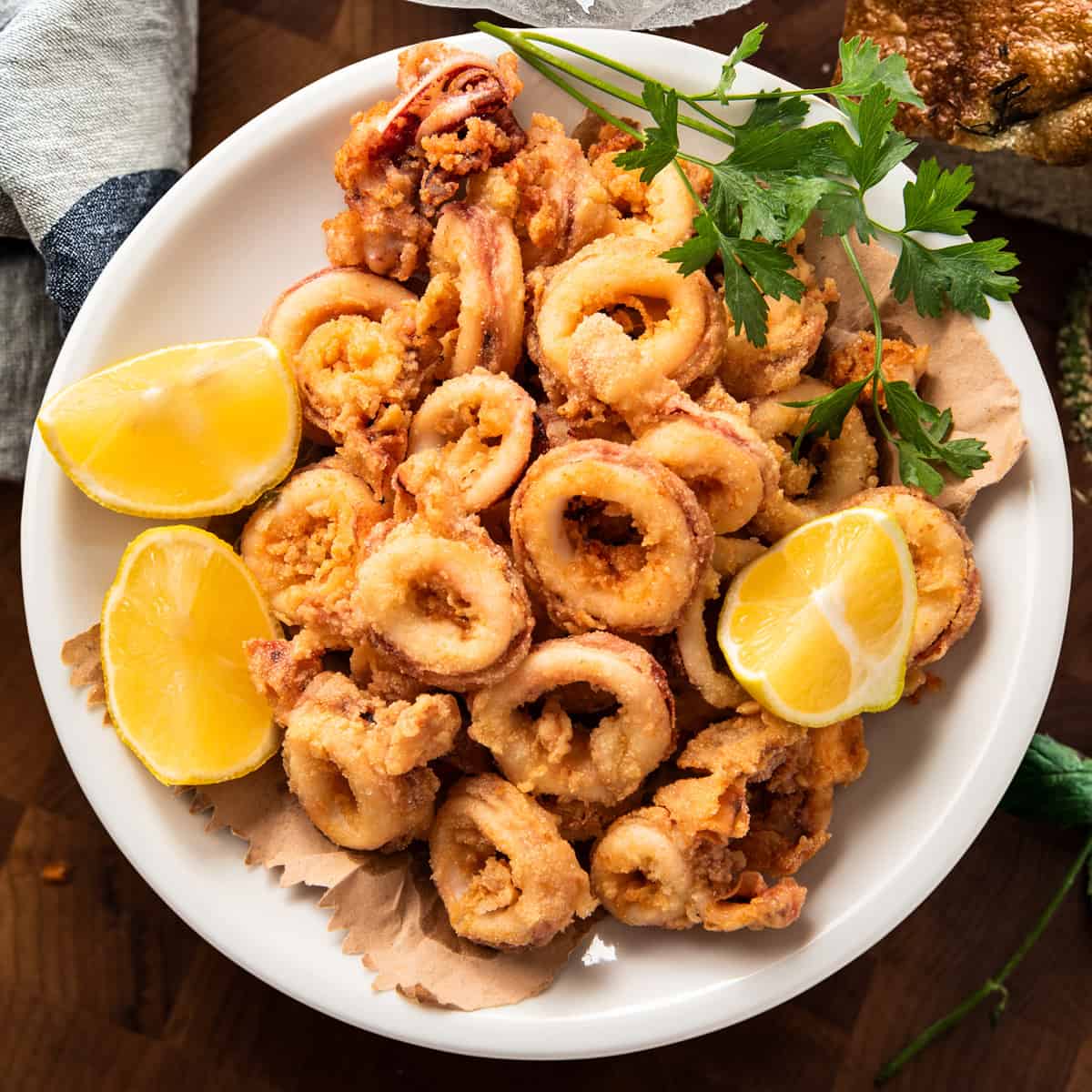
This crispy fried calamari is the one you order at every Greek taverna: tender rings of squid in a light, crackly coating, piled on a plate with lemon wedges and eaten while it’s hot. In Greece it’s called kalamarakia tiganita, and it’s one of the easiest meze you can make at home.
The secret is the coating. A mix of all-purpose flour, cornstarch, and semolina, seasoned with smoked paprika, mustard powder, and a little lemon zest, fries up golden and crunchy with no batter and no buttermilk soak. The squid only needs about 3 minutes in hot oil, which is exactly what keeps it tender instead of rubbery.

What is calamari?
Calamari is the culinary name for squid (not octopus). It’s loved all over the Mediterranean, and in Greece it’s most often fried and served as a meze with lemon wedges, tzatziki, and other small plates. Greeks also cook squid in tomato sauce, in wine, or baked with orzo.
Squid is at its best from October to May. Fresh squid is pale white to yellowish with dense reddish-gray spots. To check freshness, peel back a little of the thin skin with your fingernail: if the flesh underneath is white, it’s fresh; if it’s pink, it’s 2 to 3 days old; if it’s red, skip it.
Why you will love crispy fried calamari

In Greece, fresh calamari means dinner. See more taverna favorites in my Mediterranean diet dinner ideas.
Here is what you need

- Calamari. Cleaned, sliced squid rings and tentacles, fresh or frozen. Most US grocery stores carry frozen cleaned calamari, and many fish counters sell it fresh. If you buy whole squid, ask your fishmonger to clean it and slice the tubes into rings.
- All-purpose flour, cornstarch, and semolina. Use fine semolina (the kind for pasta or halva). Note: Greeks call cornstarch “corn flour.” In the US, look for cornstarch, not corn flour, which is ground cornmeal.
- Mustard powder and smoked paprika.
- Lemons. A little zest goes in the coating, and the rest is cut into wedges for serving.
- Oil for frying. I use sunflower oil. Any neutral oil with a high smoke point, like canola or peanut, works too.
How to buy and prep calamari
Frozen calamari is the easiest option. Thaw it overnight in the fridge, or seal it in a zip-top bag and submerge it in cold water for about 30 minutes.
Dry it really well. This step makes or breaks crispy calamari. Drain the squid in a colander, then pat it completely dry with paper towels. Wet squid makes the coating gummy and makes the oil spatter.
Slicing. Cut tubes into rings about ½ inch wide. Leave the tentacles whole.
Freezing fresh squid. Clean it, pat it dry, and freeze it flat in zip-top freezer bags. Kept solidly frozen, it’s good for several months.
How to make kalamarakia tiganita

- Prep the squid. Drain the calamari in a colander and pat it completely dry with paper towels.
- Make the coating. In a large bowl, whisk together the all-purpose flour, cornstarch, semolina, mustard powder, smoked paprika, lemon zest, and sea salt.

- Coat the calamari. Add the calamari to the bowl and toss until every piece is well coated.
- Heat the oil. Pour the oil into a deep, heavy skillet or Dutch oven to a depth of 1½ to 2 inches (no more than halfway up the sides). Heat over medium-high until it reaches 350 to 365°F (175 to 185°C) on a thermometer.

- Fry in batches. Shake a handful of calamari to knock off the extra coating, then carefully lower it into the oil without crowding the pan. Fry until golden and crispy, about 3 minutes. Don’t go longer, or the calamari will turn hard and chewy.
- Drain and repeat. Lift the calamari onto a wire rack or a paper towel-lined plate. Let the oil come back to 350°F before frying the next batch.
- Serve right away with lemon wedges on the side.
INSIDER TIP. Serve the lemon wedges on the side, and don’t squeeze lemon over the whole platter. Lemon is perfect with calamari, but it softens the coating. Let everyone squeeze their own once it’s on their plate.
Tips for tender, not rubbery, calamari
- Watch the clock. Calamari is either cooked fast (2 to 3 minutes) or slowly braised for a long time. Anything in between turns it rubbery.
- Fry in batches. Too much calamari at once drops the oil temperature, and the coating soaks up oil instead of crisping.
- Use a thermometer. Below 350°F the calamari turns greasy; well above 365°F the coating browns before the squid is cooked.
- Optional: coat as you go. If you’re frying a big batch, you can coat the calamari a handful at a time, right before it goes into the oil. The coating on calamari that sits can get damp, so this keeps the last batch as crisp as the first.
How to serve kalamarakia tiganita
At a Greek taverna, kalamarakia come to the table with the other meze and everyone digs in. I first had taverna fries at a fish taverna on Hydra, served right next to the calamari, octopus, langoustines, and armyra, a salad of sea greens. That’s still how I love to eat them.
Serve your calamari with Greek fries (patates tiganites), tzatziki, a village salad, fried eggplant and zucchini, fava dip and shrimp saganaki. For a full spread, add horta, skordalia, taramosalata, cod fish cakes, or Greek roasted feta dip. Planning a bigger meze table? See 8 Greek dips that belong on every table.
Storage and leftovers
Fried calamari is best eaten right away. Leftovers keep in an airtight container in the fridge for 1 to 2 days. To re-crisp, spread them on a baking sheet and reheat in a 400°F oven for 4 to 5 minutes. Avoid the microwave, which makes them soggy and tough.
Cooked it? Rate it!
If you tried this recipe, I’d love to know how you liked it — drop a comment below or tag me on Instagram @thegreekfoodie__.

FAQ
You may also like




Crispy Fried Calamari (Kalamarakia Tiganita)
Ingredients
- ⅔ cup 85 g all-purpose flour
- ⅔ cup 85 g cornstarch
- ⅓ cup 55 g fine semolina
- 1 tablespoon mustard powder
- 1 tablespoon smoked paprika
- 1 teaspoon lemon zest
- 1 teaspoon sea salt
- 2 lb 900 g calamari, cleaned and sliced into rings, thawed if frozen
- Sunflower oil, for frying (or another neutral oil)
- 2 lemons, cut into wedges, for serving
- Fresh parsley, for garnish (optional)
Instructions
- Prep the squid. Drain the calamari in a colander and pat it completely dry with paper towels.
- Make the coating. In a large bowl, whisk together the all-purpose flour, cornstarch, semolina, mustard powder, smoked paprika, lemon zest, and sea salt.
- Coat the calamari. Add the calamari to the bowl and toss until every piece is well coated.
- Heat the oil. Pour the oil into a deep, heavy skillet or Dutch oven to a depth of 1½ to 2 inches (no more than halfway up the sides). Heat over medium-high until it reaches 350 to 365°F (175 to 185°C) on a thermometer.
- Fry in batches. Shake a handful of calamari to knock off the extra coating, then carefully lower it into the oil without crowding the pan. Fry until golden and crispy, about 3 minutes. Don’t go longer, or the calamari will turn hard and chewy.
- Drain and repeat. Lift the calamari onto a wire rack or a paper towel-lined plate. Let the oil come back to 350°F before frying the next batch.
- Serve right away with lemon wedges on the side.
Notes
- • Calamari: Frozen cleaned calamari works perfectly. Thaw it completely and pat it very dry.
• Cornstarch: Greeks call it “corn flour.” In the US, use cornstarch, not corn flour (ground cornmeal).
• Don’t over-fry: About 3 minutes is all it needs. Longer, and the calamari turns hard and chewy.
• Fry in batches and let the oil return to 350°F between batches.
• Optional: For extra-crisp results, coat the calamari a handful at a time, just before frying each batch.
• Lemon on the side: Squeezing lemon over the platter softens the coating. Let everyone add their own.
• Leftovers: Reheat in a 400°F oven for 4–5 minutes. Avoid the microwave.
Nutrition