
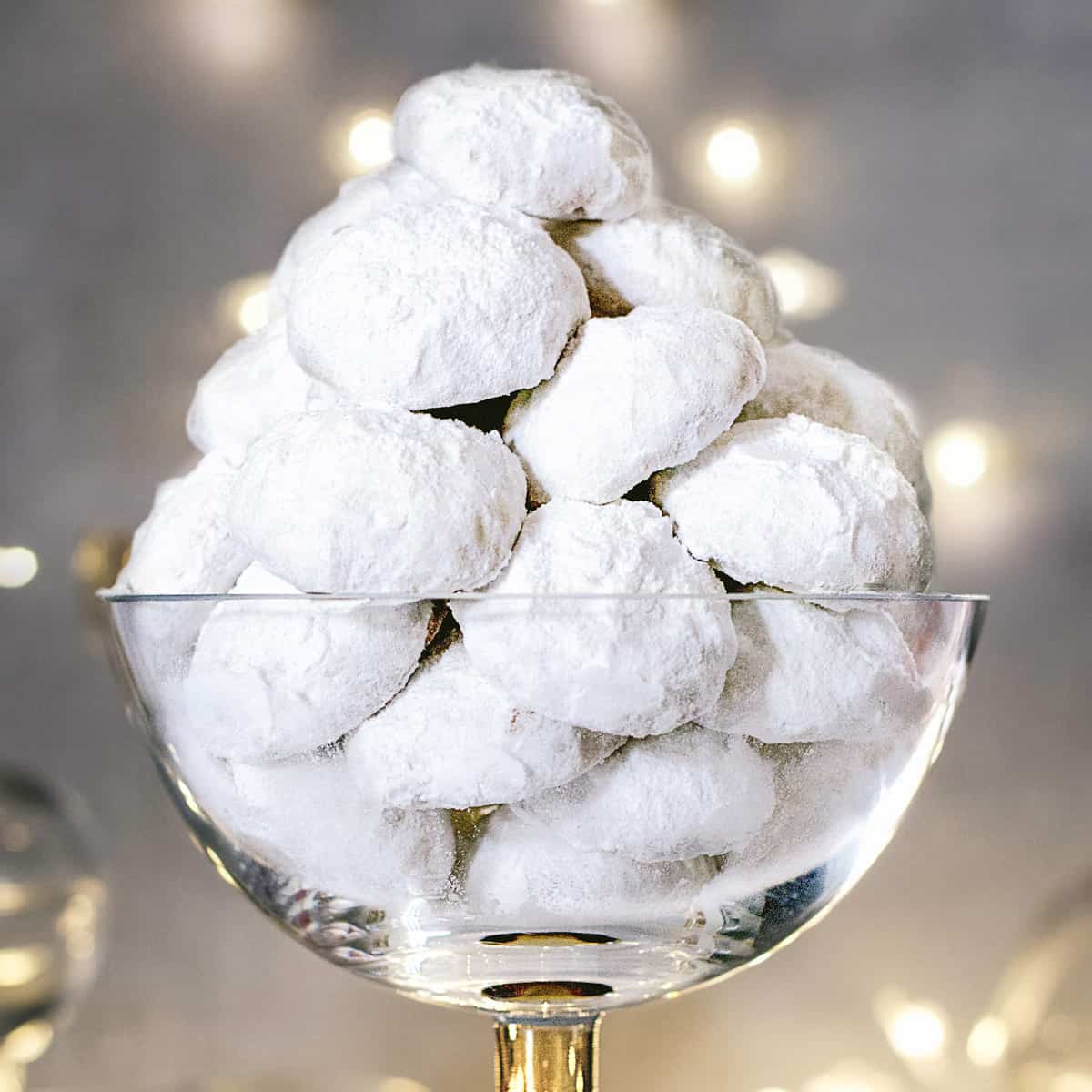
Kourabiedes are the Greek butter cookies that leave a snowfall of powdered sugar all over your sweater ! They’re tender, crumbly, packed with toasted almonds, and so buttery they melt the moment you bite in.
This recipe is built on years of testing and on the method of the great Greek pastry chef Stelios Parliaros: ghee and a long, patient beating of the butter and sugar. That’s the secret to the light, fluffy texture you find in the best Greek pastry shops.
I’ve been eating kourabiedes since I was a child, and like every Greek, I still can’t eat one without powdered sugar ending up on my nose.
If you love these, you’ll also love Melomakarona – Greek Christmas Honey Cookies and Trigona – Almond Pastry Triangles. For the whole holiday table, see my Greek Christmas Food guide.

What are kourabiedes?
Kourabiedes (κουραμπιέδες, pronounced koo-rah-bee-EH-thes) are traditional Greek butter cookies made with toasted almonds and finished with a thick coat of powdered sugar. One cookie is a kourabies. You’ll also see the name spelled kourambiedes or kourabiethes. All three are the same cookie.
They’re shortbread-like, but lighter. The butter and sugar are beaten for a long time until almost white, which gives kourabiedes their signature crumbly, melt-in-your-mouth texture. Along with melomakarona, they’re the two cookies every Greek expects to see at Christmas.
A cookie for Christmas, weddings, and baptisms
The name comes from the Turkish kurabiye. The cookie traveled across Asia Minor and Constantinople long before it became a Greek Christmas staple. It took root in Greece with the Greeks of Asia Minor after 1922. Today, the most famous kourabiedes in Greece come from Nea Karvali, near Kavala. Refugees from Karvali in Cappadocia founded the village in 1924, bringing their recipe with them.
In Greece, kourabiedes fill pastry shop windows from November through Epiphany. They’re also the cookie of joyful occasions all year: they’re handed out at weddings and baptisms, their snowy white sugar a wish for a sweet, happy life. That’s why you’ll sometimes hear them called Greek wedding cookies.
Here is what you need

- Ghee. Ghee or clarified butter, softened to room temperature. It’s what gives kourabiedes their clean, rich flavor and crumbly texture. Unsalted butter works too.
- Unpeeled whole almonds. They’ll roast and then grind into medium-large pieces.
- Dark rum or Amaretto Disaronno. Amaretto is a sweet almond liqueur, great for kourabiedes.
- Ground nutmeg. I love grinding my nutmeg from the seed. Nutmeg gives kourabiedes a perfect aroma.
- Powdered sugar. Powdered (confectioners’) sugar, for the dough and plenty more for coating the cookies.
- Unbleached all-purpose flour.
- Vanilla extract.
- Baking powder.
- Rose water. Sprinkle a touch of rose water over the cookies before rolling them in the icing sugar. Leaves a faint, beautiful aroma. Optional, not shown in the ingredients photo.
Step by step
- Roast the almonds. Preheat the oven to 320°F / 160°C. Spread the almonds on a rimmed baking sheet and roast for about 15 minutes, until deep golden. Let them cool completely, then pulse in a food processor into coarse pieces, or crush with a mortar and pestle.

- Beat the ghee and sugar. Raise the oven to 340°F / 170°C. Using the whisk attachment, beat the ghee with 110 g powdered sugar on high speed for about 20 minutes, until very pale and fluffy.
- Add the dry ingredients. Lower the speed. Gradually add the flour, baking powder, nutmeg, and vanilla, then keep beating on low for 10 minutes, until the mixture is a white, fluffy cream.
- Fold in the almonds and rum. Remove the bowl from the mixer and fold in the cooled almonds and the rum by hand. The almonds must be cool, or the dough will tighten.
- Rest the dough. Cover and let the dough rest for 20 minutes. This makes it easier to shape.
- Shape. Roll the dough into balls about 1½ inches across. Press each one lightly on top with your finger and set them on a parchment-lined baking sheet.

- Bake. Bake for 20–30 minutes, depending on size, until set but still pale. They should not brown.
- Cool completely. Let the cookies cool on the sheet. If using rose water, spray or sprinkle them lightly.
- Coat. Put the coating sugar in a large bowl. Roll the cooled cookies in it, covering them generously, then pile onto a platter. For the classic Greek look, stack them in a pyramid and dust each layer with more sugar.

Tips for the fluffiest kourabiedes
- The fluffier and creamier the butter mixture, the fluffier the cookies.
- Whipping the butter with the sugar requires high speed. But as soon as we start adding flour gradually, the speed needs to be low to avoid ruining the fluffy texture of the butter-and-sugar mixture.
- Kourabiedes are baked at a low temperature for 20 to 30 minutes. They should come out of the oven with a light color and without a hard texture.
- Dust the cookies with powdered sugar only once they’re completely cool. If they’re still warm, the sugar melts into a thick, pasty layer.
- The almonds need to be cool when added to the dough. Otherwise, the dough will tighten significantly.
- The dough should be soft, buttery, and pliable. Allow the dough to rest covered for 20 minutes. This will make the cookies easier to shape.
- It is not recommended to cut the cookies with a cookie cutter. It is better to shape them by hand due to the almond pieces. You can skip the almonds and use cookie cutters to shape them into stars, hearts, etc.
Storage and leftovers
Kourabiedes soak up moisture fast, so keep them covered whenever they’re not on the table.
- Room temperature: store in an airtight tin or container in a cool, dry place. They keep for about 2 weeks. Put parchment between the layers so they don’t rub against each other.
- The old-fashioned way: a reader shared how her mother stored them, buried in powdered sugar. Spread a thin bed of sugar in a tin, add a layer of cookies, cover with more sugar, and repeat. The sugar sweetens and protects them.

Kourabiedes FAQ
More Greek Christmas sweets
Holiday dishes
Cooked it? Rate it!
If you tried this recipe, I’d love to know how you liked it — drop a comment below or tag me on Instagram @thegreekfoodie__.



Kourabiedes (Greek Christmas Butter Cookies)
Equipment
- Rimmed baking sheet
- Parchment paper
- Food processor
- Mixer (hand mixer or tabletop)
Ingredients
- 300 g ghee or clarified butter, softened, (1⅓ cups plus 1 tablespoon)
- 120 g whole unpeeled almonds, (scant 1 cup)
- 2 teaspoons vanilla extract
- ½ teaspoon baking powder
- 110 grams powdered sugar, for the dough, (1 cup)
- 25 ml dark rum or Amaretto, (1 tablespoon plus 2 teaspoons)
- 600 g unbleached all-purpose flour, spooned and leveled, (about 4¾ cups)
- ½ teaspoon ground nutmeg, freshly grated if possible
- 1 cup rose water, optional, for spraying
- 2 cups powdered sugar, for coating, (240 g)
Instructions
- Roast the almonds. Preheat the oven to 320°F / 160°C. Spread the almonds on a rimmed baking sheet and roast for about 15 minutes, until deep golden. Let them cool completely, then pulse in a food processor into coarse pieces, or crush with a mortar and pestle.
- Beat the ghee and sugar. Raise the oven to 340°F / 170°C. Using the whisk attachment, beat the ghee with 110 g powdered sugar on high speed for about 20 minutes, until very pale and fluffy.
- Add the dry ingredients. Lower the speed. Gradually add the flour, baking powder, nutmeg, and vanilla, then keep beating on low for 10 minutes, until the mixture is a white, fluffy cream.
- Fold in the almonds and rum. Remove the bowl from the mixer and fold in the cooled almonds and the rum by hand. The almonds must be cool, or the dough will tighten.
- Rest the dough. Cover and let the dough rest for 20 minutes. This makes it easier to shape.
- Shape. Roll the dough into balls about 1½ inches across. Press each one lightly on top with your finger and set them on a parchment-lined baking sheet.
- Bake. Bake for 20–30 minutes, depending on size, until set but still pale. They should not brown.
- Cool completely. Let the cookies cool on the sheet. If using rose water, spray or sprinkle them lightly.
- Coat. Put the coating sugar in a large bowl. Roll the cooled cookies in it, covering them generously, then pile onto a platter. For the classic Greek look, stack them in a pyramid and dust each layer with more sugar.
Notes
- The fluffier the ghee and sugar mixture, the fluffier the cookies. Beat on high, then switch to low the moment the flour goes in.
- Bake low and slow. Kourabiedes should come out pale and set, never browned or hard.
- Coat with sugar only once the cookies are completely cool.
- The almonds must be cool before folding in, or the dough tightens.
- The dough should be soft, buttery, and pliable. If it cracks and crumbles, it has too much flour or too many almonds.
- Shape by hand; almond pieces make cookie cutters messy. Skip the almonds if you want cut-out shapes.
Nutrition